 We're so confident of our products that we provide no hassle product exchange.


Salesforce Mule-Dev-301 Exam Overview:
| Certification Vendor: | Salesforce |
|---|---|
| Exam Name: | Salesforce Certified MuleSoft Developer II (Mule-Dev-301) |
| Exam Number: | Mule-Dev-301 |
| Available Languages: | English |
| Exam Format: | Multiple Choice, Scenario-based Questions, Multiple Select |
| Real Exam Qty: | Approximately 60 questions |
| Certificate Validity Period: | 1 year (maintenance required annually via Salesforce certification maintenance program) |
| Exam Duration: | 120 minutes |
| Exam Price: | $200 USD |
| Related Certifications: | Salesforce Certified MuleSoft Developer I |
| Passing Score: | 70% |
| Recommended Training: | MuleSoft Official Training MuleSoft Training on Trailhead |
| Exam Registration: | Salesforce Certification Portal Pearson VUE Salesforce Exams |
| Sample Questions: | Salesforce Mule-Dev-301 Sample Questions |
| Exam Way: | Online proctored exam or onsite testing center (Pearson VUE) |
| Pre Condition: | Recommended: MuleSoft Developer I certification or equivalent MuleSoft development experience |
| Official Syllabus URL: | https://trailhead.salesforce.com/credentials/mulesoftdeveloperii |
Salesforce Mule-Dev-301 Exam Syllabus Topics:
| Section | Objectives |
|---|---|
| Topic 1: Deployment and Testing | - Deployment strategies across environments - Unit testing and integration testing approaches |
| Topic 2: DataWeave and Data Transformation | - DataWeave scripting and transformations - Mapping, filtering, and payload manipulation |
| Topic 3: Error Handling and Troubleshooting | - Debugging and logging techniques - Exception handling strategies in Mule applications |
| Topic 4: Integration and API-led Connectivity | - System, Process, and Experience APIs design - API-led connectivity principles |
| Topic 5: Anypoint Platform Development | - Anypoint Studio usage and project structure - Mule application development |
| Topic 6: Security and Governance | - API policies and security enforcement - Authentication and authorization mechanisms |
Salesforce Certified MuleSoft Developer II Sample Questions:
Refer to the exhibits.
A Mule application contains two policies: Policy A and Policy B. Policy A has order 1, and Policy B has order 2. Policy A, Policy B, and a flow are defined by the configurations below.
When an HTTP request arrives at the Mule application's endpoint, what will be the execution order?
Exhibit: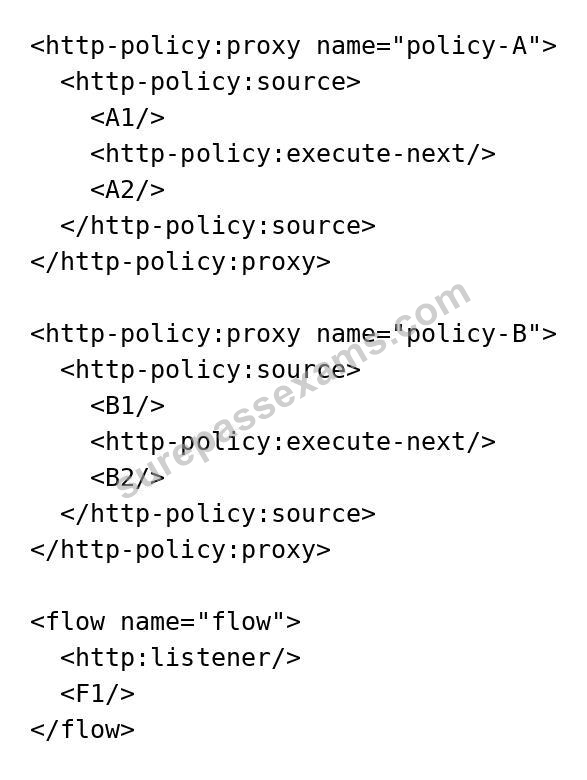
- A. A1, B1, F1, B2, A2
- B. B1, A1, F1, A2, B2
- C. F1, B1, A1, A2, B2
- D. F1, A1, B1, B2, A2
Correct Answer: A 🗳️
Explanation: Only visible for SurePassExams members. You can sign-up / login (it's free).
A custom policy needs to be developed to intercept all outbound HTTP requests made by Mule applications.
Which XML element must be used to intercept outbound HTTP requests?
- A. http-policy:operation
- B. http-policy:processor
- C. It is not possible to intercept outgoing HTTP requests, only inbound requests
- D. http-policy:source
Correct Answer: A 🗳️
Refer to the exhibit.
What required changes can be made to give a partial successful response in case the United Airlines API returns with a timeout?
Exhibit: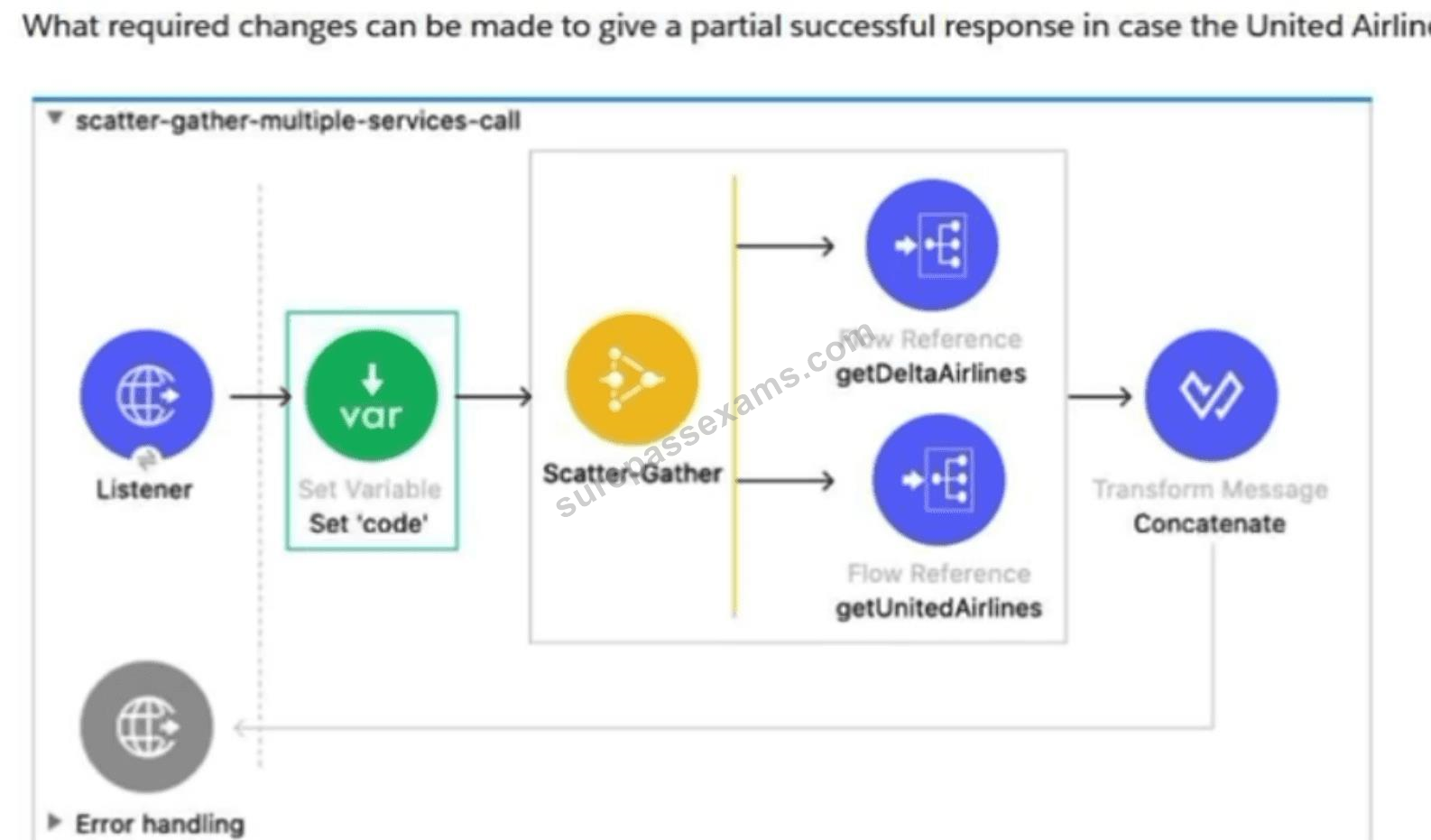
- A. Add Flow Reference components inside a Try scope. Set the payload to a default value "" inside the error handler using the On Error Continue scope.
- B. Add a Scatter-Gather component inside a Try Scope. Set the payload to a default value "Error" inside the error handler using the On Error Propagate scope.
- C. Add a Scatter-Gather component inside a Try Scope. Set the payload to a default value "Error" inside the error handler using the On Error Continue scope.
- D. Add Flow Reference components inside a Try Scope. Set the payload to a default value "" inside the error handler using the On Error Propagate scope.
Correct Answer: A 🗳️
Explanation: Only visible for SurePassExams members. You can sign-up / login (it's free).
A healthcare portal needs to validate the token that it sends to a Mule API. The developer plans to implement a custom policy using the HTTP Policy Transform Extension to match the token received in the header from the healthcare portal.
Which files does the developer need to create in order to package the custom policy?
- A. XML template file, YAML configuration file
- B. Deployable ZIP file, YAML configuration file
- C. JSON properties file, YAML configuration file
- D. JSON properties file, XML template file
Correct Answer: A 🗳️
Explanation: Only visible for SurePassExams members. You can sign-up / login (it's free).
Refer to the exhibits.
The HTTP Request operation raises an HTTP:CONNECTIVITY error.
Which HTTP status code and body are returned to the web client?
Exhibit: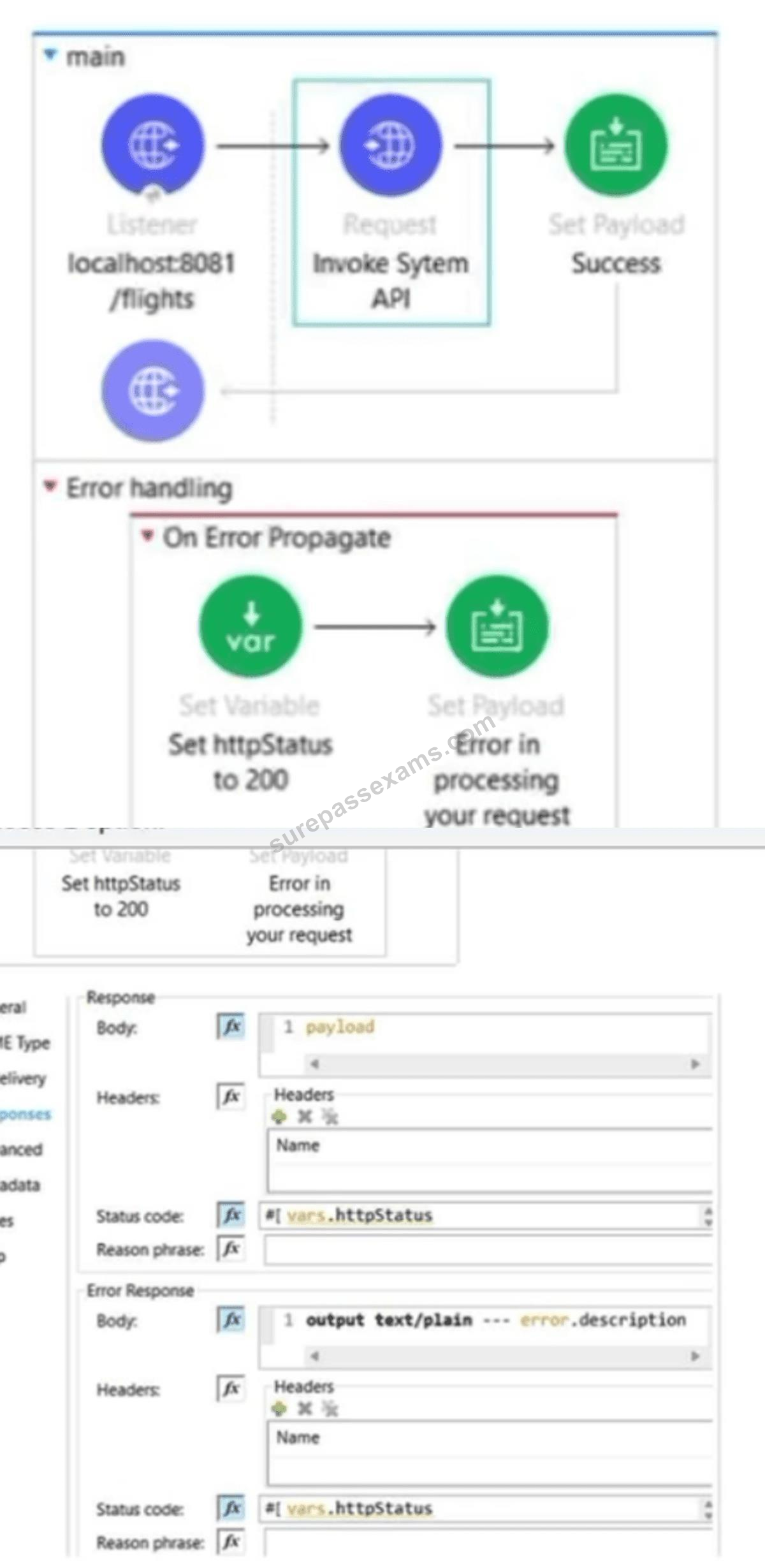
- A. HTTP Status Code: 200. Body: The HTTP:CONNECTIVITY error description.
- B. HTTP Status Code: 500. Body: "Error in processing your request."
- C. HTTP Status Code: 500. Body: The HTTP:CONNECTIVITY error description.
- D. HTTP Status Code: 200. Body: "Error in processing your request."
Correct Answer: A 🗳️
Explanation: Only visible for SurePassExams members. You can sign-up / login (it's free).
Viewing page 1 out of 13 pages.
Viewing questions 1-5 out of 62 questions.
 By Tabitha