

2025 The Most Effective GES-C01 with 351 Questions Answers
Try Free and Start Using Realistic Verified GES-C01 Dumps Instantly.
NEW QUESTION # 102
A data operations team is attempting to scale up their Document AI automated pipeline. They are using a Snowflake Task to process a large volume of daily scanned invoices and receipts, which are stored in an internal stage 'financial_docs stage'. The current processing involves documents that are frequently around 75 MB each, and often there are batches exceeding 1 ,200 documents in a single day. The pipeline is failing consistently. Which of the following factors could be contributing to the failures in this Document AI automated pipeline? (Select all that apply.)
- A. The number of documents in a single daily batch (exceeding 1 ,200) surpasses Document AI's processing limit per query.
- B. The individual document size (75 MB) exceeds the maximum supported file size for Document AI.
- C. The account role executing the task lacks the 'SNOWFLAKCORTEX USER database role, which is a prerequisite for Document AI functions.
- D. The Snowflake Task is configured as a 'SERVERLESS TASK, which is not supported by Document AI.
- E. The was created without specifying 'ENCRYPTION = (TYPE = 'SNOWFLAKE SSE')'.
Answer: A,B,D,E
Explanation:
NEW QUESTION # 103
A developer is building a prototype Gen AI application using the Snowflake Cortex LLM REST API. During testing, they frequently encounter HTTP 429 'Too Many Requests' errors, particularly when rapidly invoking the 'COMPLETE endpoint. Which of the following statements accurately describes the usage quotas and troubleshooting steps for such rate limit events in the Cortex REST API?
- A. Rate limits are model-specific, and exceeding either the Tokens Processed per Minute (TPM) or Requests per Minute (RPM) limits will result in an HTTP 429 response code.
- B. To resolve rate limiting, the developer should increase the virtual warehouse size for their API requests, as larger warehouses automatically increase API quotas.
- C. The HTTP 429 response indicates that the daily credit consumption for Snowflake Cortex AISQL usage has exceeded the 10-credit limit for on-demand accounts without a valid payment method, requiring conversion to a paid account.
- D. If the usage is below the RPM limit but still triggers a 429, the developer should review the token usage rate as TPM limits might be exceeded.
- E. Cortex REST API rate limits are primarily based on Requests per Minute (RPM) and do not consider the total Tokens Processed per Minute (TPM).
Answer: A,D
Explanation:
Option C is correct because the Cortex REST API implements rate limits for both Tokens Processed per Minute (TPM) and Requests per Minute (RPM), and offending either of these limits will result in a 429 response code. Option D is correct as the sources explicitly state that if REST API usage is below the RPM limit but still receives a 429, the user should double-check the token usage rate, implying that TPM limits could be the cause. Option A is incorrect because while on-demand Snowflake accounts without a valid payment method are limited to 10 credits per day, an HTTP 429 specifically refers to rate limiting due to high usage, not a daily credit budget exceeding for the account type. Option B is incorrect as Cortex REST API rate limits consider both TPM and RPM. Option E is incorrect because Cortex REST API requests do not require a warehouse, and increasing warehouse size does not directly increase API quotas or resolve rate limiting for the REST API.
NEW QUESTION # 104
A data engineer is developing an AI-infused data pipeline in Snowflake Notebooks to analyze Federal Reserve Meeting Minutes and official Statements, which are initially in PDF format. The goal is to determine the FED's stance on interest rates (hawkish, dovish, or neutral) and the reasoning for each ingested PDF using an LLM. The pipeline needs to automate data ingestion, text extraction, LLM inference, and store the results in a Snowflake table. Which sequence of operations and Snowflake features is most appropriate for building this pipeline within Snowflake?
- A. Scrape data from an external website directly into a Snowflake table using an 'EXTERNAL FUNCTION'. Then, apply 'SNOWFLAKE.CORTEX.EXTRACT ANSWER with a question like 'What is the FED's stance?' and 'SNOWFLAKE.CORTEX.SUMMARIZE' for reasoning to enrich the table. Automate this using 'STREAMS' and 'TASKS.
- B. Load unstructured PDF files into an internal stage. Use a stored procedure to download new PDFs from the FOMC website. Leverage Snowpark Container Services to deploy a fine-tuned open-source LLM (e.g., Llama 2) for text extraction and sentiment analysis, and orchestrate the pipeline with ' Dynamic TableS for continuous updates.
- C. Directly ingest PDF documents into a 'VARIANT column in a Snowflake table. Then, use the SQL function in 'OCR mode to extract text and layout. The extracted text is then passed to 'SNOWFLAKE.CORTEX.CLASSIFY TEXT to determine the sentiment, and the results are stored in a new table.
- D. Scrape PDF data from an external website, load unstructured PDF files to an internal stage, then use a 'UDE to parse raw text from PDFs and a separate UDF' ('GENERATE_PROMPT) to encapsulate a custom prompt. Finally, use a 'TASK' to automate the process, calling Snowflake's function with the custom prompt at the point of ingestion to generate the sentiment signal and reasoning.
- E. Ingest PDF documents into a directory table. Use 'Document AI' C!PREDICT') to extract specific entities and tables from the PDFs into structured JSON. Then, create a 'STREAM' on the stage and a 'TASK' to continuously process new documents, extracting information and potentially performing additional sentiment analysis with another LLM.
Answer: D,E
Explanation:
Option A is correct. This option directly aligns with the 'AI-Infused Pipelines with Snowflake Cortex' blog post. It describes scraping data, loading to an internal stage, using a stored procedure to download new PDFs, and 'UDFS for parsing text and generating prompts. It explicitly mentions using 'Snowflake's TRY_COMPLETE function for LLM inference with a custom prompt at ingestion, all automated with 'Streams' and 'Tasks'. Option B is incorrect. PARSE DOCUMENT in 'OCR mode extracts text but does not preserve layout and primarily focuses on text and layout extraction, not directly sentiment analysis or complex reasoning. While 'CLASSIFY _ TEXT (or can classify text, 'AI PARSE DOCUMENT is for extracting text and layout from documents, not direct ingestion into a 'VARIANT' column for text extraction via 'OCR mode. is a Cortex AI SQL function, typically used on files stored in stages. Option C is incorrect. While Snowpark Container Services can host LLMs and Dynamic Tables can automate updates, using an external LLM for text extraction when 'Document AI' or are available for native PDF processing is not the most direct approach. Additionally, 'Dynamic Tables' do not support incremental refresh with 'COMPLETE , and the prompt generation and sentiment analysis would still need to be explicitly defined. Option D is incorrect. Directly scraping into a Snowflake table with an 'EXTERNAL FUNCTION' isn't covered as the primary ingestion method for PDFs in the context of LLMs for sentiment. 'EXTRACT ANSWER and 'SUMMARIZE are task-specific Cortex functions, but the core task is a multi-step pipeline for PDF content analysis, which would be better served by a robust document processing solution. The focus of the pipeline example is on PDFs, not general website scraping directly to a table for immediate LLM application. Also, 'EXTRACT_ANSWER is for extracting a specific answer, while the sentiment is a classification. Option E is correct. This option uses 'Document AI' , which is specifically designed to extract structured information (entities, tables) from unstructured documents like PDFs using 'Arctic-TILT'. It explicitly mentions creating a 'STREAM' on a stage and a "TASK' for continuous processing, which is a standard pattern for Document AI pipelines. This approach directly handles the PDF extraction and structuring into JSON, which can then be further processed for sentiment analysis or reasoning if needed. The output JSON from '!PREDICT includes various extracted fields and can be parsed.
NEW QUESTION # 105
A compliance officer is reviewing the usage of Snowflake Cortex LLM functions and the Cortex REST API within their organization, specifically focusing on the implementation and impact of Cortex Guard. They observe several instances where 'guardrails' were enabled. Which of the following statements accurately describe the behavior and cost considerations of Cortex Guard when integrated with Snowflake Cortex LLM functions or the Cortex REST API?
- A. Cortex Guard operates by evaluating responses after the LLM has fully generated its content, and it incurs additional compute cost for both input and output tokens during its processing.
- B. Cortex Guard is inherently part of all Cortex LLM functions and does not require explicit enablement via 'guardrails: TRUE for SQL functions or the REST API.
- C. Cortex Guard can be configured with a custom message using the argument in the options object for both 'COMPLETE SQL function and the Cortex REST API.
- D. The underlying model for Cortex Guard is Meta's Llama Guard 3, and its processing costs are separate from the primary LLM inference costs.
- E. When Cortex Guard is enabled and a response is deemed unsafe, the LLM-generated output is replaced with a predefined message, and only the input tokens for Cortex Guard processing ('guard_tokens') are billed, not the potentially unsafe completion tokens.
Answer: C,D,E
Explanation:
Option B is correct: when Cortex Guard is enabled and a response is blocked, the model's output is replaced by a message (defaulting to 'Response filtered by Cortex Guard'), and only 'guard_tokens' are counted as input tokens for Cortex Guard's processing, in addition to the primary LLM's prompt and completion tokens. Option C is correct as the argument allows customization of the filtered response message for both 'COMPLETE' and the REST API. Option E is correct because Cortex Guard is built with Meta's Llama Guard 3 and its usage is billed separately as 'guard_tokens' in addition to the 'COMPLETE function cost. Option A is incorrect because while guard_tokens' are billed, it's specifically for the guardrail processing, and the 'unsafe' completion tokens are not returned or billed as such, rather replaced by a filtered message. Option D is incorrect because Cortex Guard requires explicit enablement by setting 'guardrails' to 'TRUE'.
NEW QUESTION # 106
A company wants to ingest and process scanned invoices and digitally-born contracts in Snowflake. They need to extract all text, preserving layout for contracts and just the text content for scanned invoices. Which AI_PARSE_DOCUMENT modes would be most appropriate for this scenario, and what is the primary purpose of the function itself?
- A. Primary purpose is to classify text. For contracts, use LAYOUT mode; for invoices, use OCR mode.
- B. Primary purpose is to translate text. Both document types should use LAYOUT mode.
- C. Primary purpose is to generate new text. For contracts, use OCR mode; for invoices, use LAYOUT mode.
- D. Primary purpose is to extract data and layout. For contracts, use LAYOUT mode; for invoices, use OCR mode.
- E. Primary purpose is to summarize text. For contracts, use OCR mode; for invoices, use LAYOUT mode.
Answer: D
Explanation:
Option C is correct. AI_PARSE_DOCUMENT is a Cortex AI SQL function designed to extract text, data, and layout elements from documents with high fidelity, preserving structure like tables, headers, and reading order. For digitally-born contracts where layout preservation is needed, the mode is appropriate. For scanned invoices where only text content is needed without layout, the OCR mode, which extracts text LAYOUT from scanned documents and does not preserve layout, is suitable.
NEW QUESTION # 107
A data engineer is establishing a new Snowflake environment to support Document AI for processing incoming vendor invoices. They are setting up the necessary virtual warehouse, database, schema, and stages. Which of the following statements correctly identify essential considerations or requirements for this initial setup?
- A. Any internal stages used for storing documents that will be processed by Document AI must explicitly enable SNOWFLAKE_SSE encryption.
- B. Snowflake recommends using a large virtual warehouse, such as an 'L' or 'XL' size, to accommodate the intensive processing demands of Document AI and ensure high throughput.
- C. A dedicated, smaller warehouse (e.g., 'X-SMALL', 'SMALL', or 'MEDIUM') should be created for Document AI to facilitate precise cost tracking, as scaling up warehouse size does not enhance Document AI query performance.
- D. The database and schema where Document AI model builds are created can be freely altered after creation, allowing for agile schema evolution.
- E. All documents intended for a single Document AI '!PREDICT operation must be stored within the same logical directory of the specified stage.
Answer: A,C,E
Explanation:
Option A is incorrect because scaling up the warehouse size does not increase the speed of query processing for Document AI, but rather increases costs. Snowflake recommends X-Small, Small, or Medium warehouses. Option B is correct as creating a separate, smaller warehouse is recommended for cost tracking for Document AI workloads. Option C is correct as internal stages for Document AI must use server- side encryption C SNOWFLAKE_SSE). Option D is incorrect because DocumentAl does not support altering a database or schema where the model build is located. Option E is correct as all documents for an operation must be in the same stage directory.
NEW QUESTION # 108
An operations team at a company is implementing a robust governance framework to monitor and optimize the costs associated with their Snowflake Cortex LLM function usage. They need to identify which functions are driving the highest token consumption and overall credit usage to pinpoint areas for cost reduction. Which of the following monitoring tools or methods are appropriate for gaining these insights into Cortex LLM function costs and token consumption?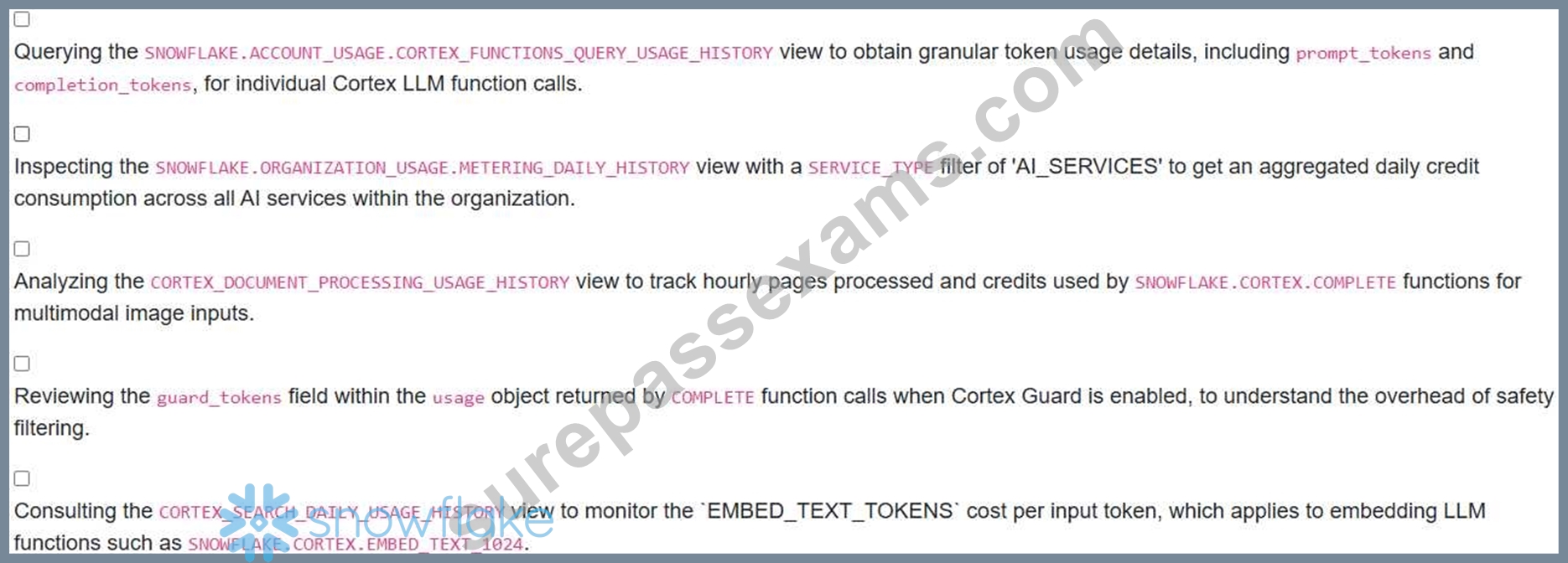
- A. Option A
- B. Option D
- C. Option E
- D. Option B
- E. Option C
Answer: A,B,C,D
Explanation:
Option A is correct because the 'SNOWFLAKE.ACCOUNT USAGE.CORTEX_FUNCTIONS_QUERY_USAGE_HISTORY view provides granular usage information, including 'prompt_tokens' and 'completion_tokens' , for individual Cortex LLM function calls and the models used. Option B is correct because the 'METERING DAILY HISTORY view, found in the 'ACCOUNT USAGE schema (or 'ORGANIZATION_USAGE' for organization-wide), can be filtered by 'SERVICE_TYPE = 'AI_SERVICES" to retrieve daily aggregated credit consumption for all AI services, including Cortex LLM functions. Option D is correct because when 'Cortex Guard' is enabled for 'COMPLETE calls, the response's 'usage' object includes a 'guard_tokens' field, which indicates the tokens consumed by the guardrail processing. Monitoring this helps understand its cost and identify prompts that frequently trigger it. Option E is correct because the view is used to monitor the cost associated with ' per input token, which is directly relevant to embedding LLM functions like 'EMBED TEXT 1024'. Option C is incorrect because the view specifically tracks Document AI processing functions (e.g., 'PREDICT , 'PARSE_DOCUMENT, SAI_EXTRACT) and reports pages processed, not SNOWFLAKE.CORTEX.COMPLETE function usage for multimodal inputs.
NEW QUESTION # 109
A security administrator is implementing strict model access controls for Snowflake Cortex LLM functions, including those accessed via the Cortex REST API. By default, the 'SNOWFLAKE.CORTEX USER' database role is granted to the 'PUBLIC' role, allowing all users to call Cortex AI functions. To enforce a more restrictive access policy, the administrator revokes 'SNOWFLAKE.CORTEX USER from 'PUBLIC'. Which of the following actions must the administrator take to ensure specific roles can 'still' make Cortex REST API requests, and what are the implications?
- A. The from 'SNOWFLAKCORTEX USER database role is only required for SQL functions, not for the Cortex REST API, so no further action is needed after revoking 'PUBLIC for REST API access.
- B. Access for Cortex REST API is managed independently of database roles; a separate REST API key must be provisioned for each user or application.
- C. Only the role can make cortex REST API calls after revoking 'SNOWFLAKE.CORTEX_USER from 'PUBLIC', as this role inherently bypasses all other access controls.
- D. The 'SNOWFLAKE.CORTEX USER database role must be granted directly to individual users who need access, as it cannot be granted to other account roles.
- E. The 'SNOWFLAKE.CORTEX USER database role must be granted to the specific account roles, and then these account roles must be granted to users. Additionally, the account parameter can be used to restrict which models are accessible.
Answer: E
Explanation:
To send a REST API request to Cortex, the default role of the calling user must be granted the 'SNOWFLAKE.CORTEX_USER database role. By default, this role is granted to 'PUBLIC', but it can be revoked. If revoked, the 'CORTEX USER role must be explicitly granted to other account roles, which are then granted to users. The 'CORTEX_USER role cannot be granted directly to a user. The 'CORTEX MODELS_ALLOWLIST' parameter can also be used to restrict which models are accessible at the account level for Cortex functions, including those accessed via the REST API. Therefore, option B correctly outlines the required actions and an additional control. Options A, C, D, and E are incorrect as they misrepresent the access control mechanisms or requirements for Cortex REST API.
NEW QUESTION # 110
A financial analytics team is developing an application to extract specific, structured financial data (e.g., company name, revenue, profit margin) from various news articles using Snowflake Cortex LLM functions. They require the output to strictly conform to a predefined JSON schema and want to ensure robust error handling. Which of the following statements are crucial considerations for achieving this goal?
- A. To guarantee that critical fields like 'company name' and 'revenue' are always extracted, these properties must be explicitly listed within the ' required' array of the JSON schema provided to AI_COMPLETE.
- B. Setting the temperature option to 0 in the AI_COMPLETE call is essential for obtaining the most consistent and accurate structured JSON outputs, regardless of task complexity or model used.
- C. The AI_COMPLETE function should be used with the response_format argument, supplying a JSON schema object that defines the required structure, data types, and constraints for the output.
- D. For enhanced reliability in production pipelines, the team should wrap their AI_COMPLETE calls within TRY_COMPLETE, as it returns a structured error object if the model fails to adhere to the schema, allowing for detailed debugging.
- E. The complexity of the JSON schema provided to AI_COMPLETE has no impact on compute costs, as only the input text and generated content tokens are billed.
Answer: A,B,C
Explanation:
Option A is correct. AI_COMPLETE Structured Outputs allows specifying a JSON schema via the argument to ensure response _ format responses follow a defined structure, data types, and constraints. Option B is correct. Using the field in the JSON schema ensures that required specified properties are extracted, or an error is raised by making extraction of critical information reliable. Option C is incorrect. COMPLETE, performs the same operation as COMPLETE (or AI_COMPLETE) but returns instead of raising an error when the operation cannot be TRY COMPLETE NULL performed. It does not return a structured error object for detailed debugging, but rather handles the error by returning allowing a pipeline to NULL, continue. Option D is correct. For the most consistent results and to optimize JSON adherence accuracy, it is recommended to set the temperature option to 0 when calling COMPLETE (or AI_COMPLETE). Option E is incorrect. The number of tokens processed (and billed) increases with schema complexity. A larger and more complex supplied schema generally consumes more input and output tokens, leading to higher compute costs.
NEW QUESTION # 111
A Gen AI developer is using 'SNOWFLAKE.CORTEX.COMPLETE" to generate concise summaries of legal documents. Initially, the LLM sometimes provides overly creative or slightly off-topic responses, indicating potential 'hallucinations' or a lack of focus. To improve the factual accuracy and conciseness of the summaries, which combination of prompt engineering techniques and 'COMPLETE' function options should be prioritized?
- A. Instruct the model to 'think out loud' with an inner monologue in the prompt, and set 'max_tokens' to a large value to allow full reasoning.
- B. Implement 'first principles thinking' in the prompt, clearly outlining logical steps for summarization, and set 'temperature' to 0 for deterministic output.
- C. Rely solely on a comprehensive list of 'stop sequences' to end generation when the summary is complete.
- D. Provide a 'task description' focusing on broad themes and set 'top_p' to 0.5 to balance creativity and relevance.
- E. Use a system prompt defining a persona like 'creative writer' and set 'temperature' to 0.9 to encourage diverse summaries.
Answer: B
Explanation:
To reduce 'hallucinations' and improve factual accuracy and conciseness, applying 'first principles thinking' by breaking prompts into logical steps helps the model respond from foundational concepts rather than assumptions. Setting 'temperature' to 0 yields the most consistent and deterministic results, which is crucial for factual accuracy and conciseness in summaries. Defining a 'creative writer' persona or using a high 'temperature' would increase diversity and potentially lead to more hallucinations (Option A). Instructing the model to 'think out loud' (Option C) enhances transparency of thought but does not directly enforce factual accuracy or conciseness in the way 'first principles' and low 'temperature' do. 'max_tokens' (Option C) affects output length, not necessarily accuracy or conciseness. A broad 'task description' (Option D) might not be specific enough, and 'top_p' also influences diversity. 'Stop sequences' (Option E) help with truncation but do not prevent factual errors or improve conciseness directly from the model's generation process.
NEW QUESTION # 112
A company is implementing a Document AI solution to extract sensitive financial data from invoices. They plan to fine-tune the Document AI model (Arctic-TILT) and then manage this custom model within the Snowflake Model Registry. Which of the following statements correctly outlines the access control, data handling, and model management principles for this scenario?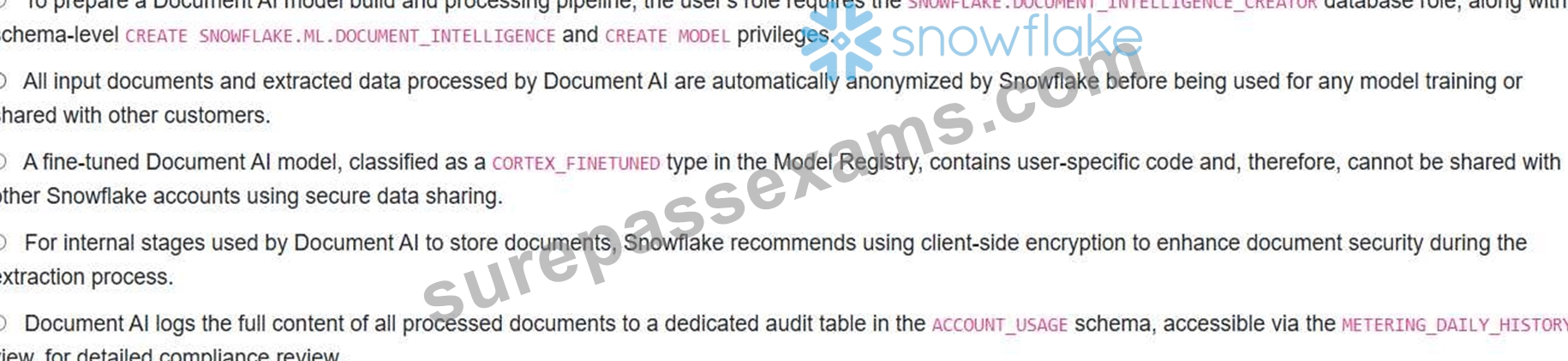
- A. Option B
- B. Option D
- C. Option A
- D. Option E
- E. Option C
Answer: C
Explanation: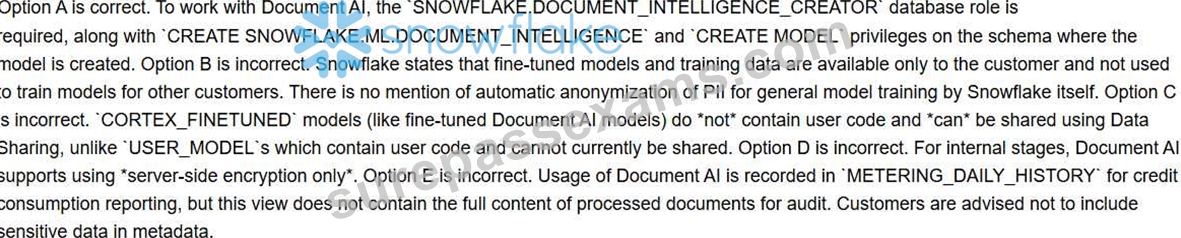
NEW QUESTION # 113
A machine learning engineer needs to fine-tune the 'mistral-7b' LLM using Snowflake Cortex for a specialized task. They have prepared training data in a Snowflake table. Which of the following statements correctly describe the process, requirements, and cost considerations for initiating this fine-tuning job?
- A. The fine-tuned model will automatically appear in the Snowflake Model Registry and is available for sharing with other accounts using Data Sharing, even if it contains user code.
- B. The 'max_epochs' option in the 'options' JSON object can be set to any positive integer to control the training duration, but it is capped at a maximum of 50 epochs.
- C. The training data query result must explicitly include columns named
- D. To create the fine-tuning job, the engineer should use the SQL command:

- E. The cost for fine-tuning is incurred based on the number of tokens used in training, calculated as:

Answer: C,D,E
Explanation:
Option A is correct because this SQL syntax accurately demonstrates how to create a fine-tuning job using the SNOWFLAKE.CORTEX.FINETUNE function, specifying 'CREATE', a name for the tuned model, the base model, and a SQL query for the training data with aliased columns for 'prompt' and 'completion'. Option B is correct because the training data query result must include columns named 'prompt' and 'completion' for the fine-tuning job to proceed successfully. Option C is incorrect. While Cortex Fine-Tuned LLMs appear in the Model Registry's Snowsight UI, they are explicitly noted as not being managed by the model registry API. Specifically, models generated with Cortex Fine-tuning ('CORTEX_FINETUNED) do not contain user code and can be shared using Data Sharing, but 'USER MODEL' types (models containing user code) cannot currently be shared. The statement implies that models *with* user code are shareable, which is not currently the case for all model types in the registry. Option D is correct as the compute cost for the Snowflake Cortex Fine-tuning function is based on the number of tokens used in training, which is calculated as 'number of input tokens ' number of epochs trained'. Option E is incorrect because the 'max_epochs' option in the 'options' object has a value range from 1 to 10 (inclusive), not up to 50.
NEW QUESTION # 114
A business is implementing Snowflake Document AI to process a high volume of scanned legal contracts. The contracts are in PDF format, average 75 pages each, and some are up to 45 MB in size. They need to extract specific clauses, contract dates, and signatory names, including any handwritten elements. The business requires the extracted data to be available for continuous processing within an automated pipeline. Which of the following considerations are critical for successful implementation of this Document AI solution?
- A. When extracting lists of values, such as multiple contract clauses, the Document AI model may initially struggle with complex extractions. It's best practice to train the model with annotations and corrections over a representative dataset to ensure accuracy and correct ordering.
- B. For continuous processing of new documents, the business needs to create a stream on a stage and a task to automate the execution of the extracting query. Document AI supports processing up to 500 documents in a single query.
- C. The primary method for extracting information is This method is exclusively designed for zero-shot extraction, thus fine-tuning is not an option to improve results on specific document types like these contracts.
- D. To train the Document AI model to extract handwritten text and signatures accurately, particularly if readability is low, the business should utilize the 'ocrScore' from the prediction results to flag documents for image quality review or enhancement.
- E. Document AI automatically detects page orientation and supports PDF as a file format. The maximum page limit of 125 pages per document and size limit of 50 MB are well within the specifications for these contracts.
Answer: A,D,E
Explanation:
Option A is correct. Document AI supports PDF, PNG, DOCX, EML, JPEG, JPG, HTM, HTML, TEXT, TXT, TIF, TIFF formats. Documents must be no more than 125 pages long and 50 MB or less in size. The contracts, at 75 pages and 45 MB, are within these limits. DocumentAI also automatically detects page orientation. Option B is correct. The accuracy of extracting handwritten information depends on text recognition. If readability is low, reviewing the document to improve image quality or using the OCR score (provided in the documentMetadata.ocrScore' field of the JSON output) to flag documents for additional review is helpful. Option C is incorrect. Document AI provides both zero-shot extraction and fine-tuning capabilities. You can fine-tune the Arctic-TILT model to improve results on documents specific to your use case. The S!PREDICT method is used for extraction after the model is ready, which can be zero-shot or fine-tuned. Option D is incorrect. While creating a stream on a stage and a task is the correct approach for continuous processing, Document AI has a limitation for the number of documents processed in one query, supporting a maximum of 1000 documents, not 500. Option E is correct. The Document AI model can return lists, and for complex extractions like lists of line items (or in this case, clauses), the foundational model may not immediately understand the intent. Training with annotations and corrections is crucial to achieve the desired output.
NEW QUESTION # 115
A data scientist fine-tuned a mistral-lb model in Snowflake for a specific customer support response generation task, naming it my_custom_responder_model. They now want to make this model available for AI_COMPLETE calls in production, ensuring proper access control and regional availability. Which of the following statements is true regarding the deployment and management of this fine-tuned model in Snowflake?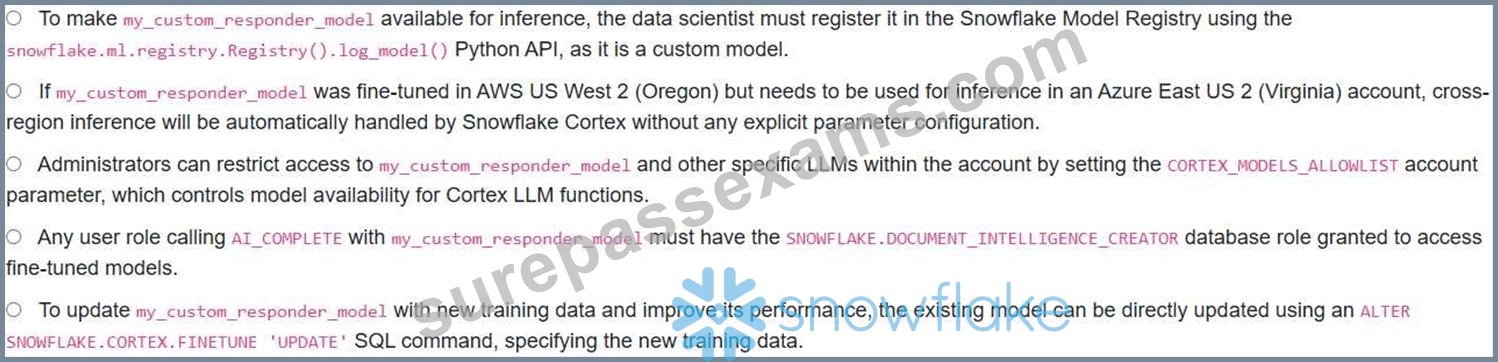
- A. Option B
- B. Option D
- C. Option E
- D. Option C
- E. Option A
Answer: D
Explanation:
NEW QUESTION # 116
A data engineering team is developing a Cortex Analyst semantic model in YAML for an e-commerce platform. They need to ensure high accuracy for common queries, improve literal matching for product names, and understand limitations for supported data types. Which of the following statements correctly describe aspects of semantic model configuration or capabilities for these requirements?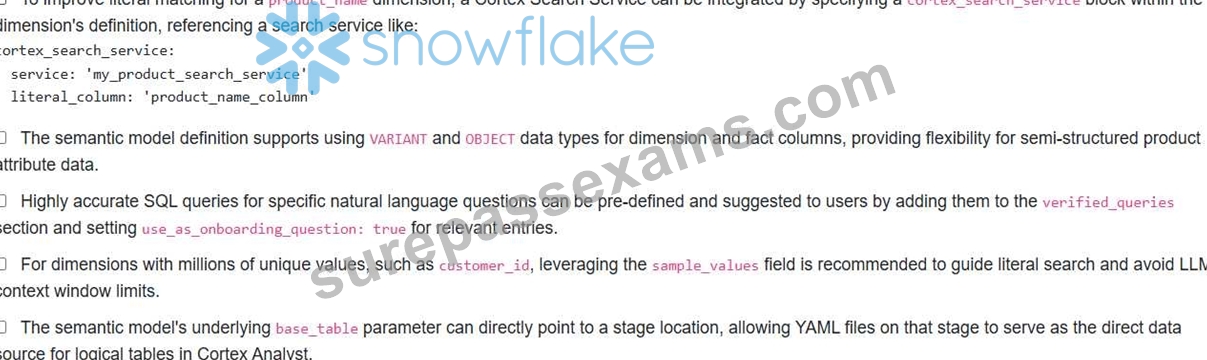
- A. Option B
- B. Option D
- C. Option A
- D. Option E
- E. Option C
Answer: C,E
Explanation:
Option A is correct. Cortex Search Services can be integrated into a dimension's definition (using the field with 'service' and fields) to improve literal matching by performing semantic search over the underlying column. This is specifically useful for 'fuzzy' searches of product names. Option C is correct. The 'verified_querieS section allows pre-defining accurate SQL queries for specific natural language questions. Setting 'use_as_onboarding_question true' for entries ensures these queries are used when relevant and presented as suggested questions to users, or as onboarding questions. Option B is incorrect because 'VARIANT , 'OBJECT , 'GEOGRAPHY , and 'ARRAY' data types are currently not supported for dimension, fact, or metric columns in a semantic model. Option D is incorrect; the 'sample_values' field is recommended for dimensions with relatively low-cardinality (approximately 1-10 distinct values) to aid in semantic search for literals, not for high-cardinality dimensions like millions of customer IDs. Option E is incorrect because a ' base_table' in a semantic model must refer to a physical database table or a view, not directly to a stage location.
NEW QUESTION # 117 
- A.

- B. Data for all these operations remains within Snowflake's governance boundary.
- C.

- D.

- E.

Answer: B
Explanation:
Option D is correct. All the mentioned Snowflake Cortex AI functions , , 'SNOWFLAKE.CORTEX.COMPLETE) are designed to operate within Snowflake's governance boundary under default configurations. uses Snowflake's proprietary Arctic-TILT model for document extraction, keeping data within the platform. Snowflake Cortex AI functions, including embedding and completion models like 'mistral-large? , are fully hosted and managed by Snowflake, ensuring data remains secure and in place. While REGION' allows processing in a different region, user inputs and outputs are not stored or cached, maintaining data within Snowflake's overall control. Therefore, no data egress to a third-party LLM provider occurs in these steps. Options A, B, and C are incorrect as they contradict the principle of Snowflake-hosted and managed AI features. Option E is incorrect because the 'CORTEX MODELS ALLOWLIST restricts which models can be used, but it does not dictate data egress, as the allowed models are still Snowflake-hosted.
NEW QUESTION # 118
A financial institution wants to automate the extraction of key entities (e.g., invoice number, total amount, list of invoice items) from incoming PDF financial statements into a structured JSON format within their Snowflake data pipeline. The extracted data must conform to a specified JSON schema for seamless downstream integration. Which Snowflake Cortex capabilities, when combined, can best achieve this data augmentation and ensure schema adherence in a continuous processing pipeline?
- A. Option E
- B. Option D
- C. Option B
- D. Option C
- E. Option A
Answer: B,C
Explanation: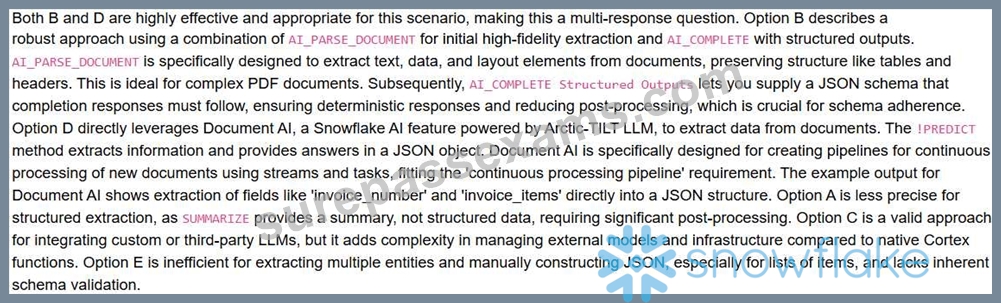
NEW QUESTION # 119
......
Download Free Latest Exam GES-C01 Certified Sample Questions: https://www.surepassexams.com/GES-C01-exam-bootcamp.html
GES-C01 Actual Questions - Instant Download 351 Questions: https://drive.google.com/open?id=19gcuMgkT2dyVdfvKWmkyID5vYIdPfwN5