

Use the best ways of preparing for SPLK-3001 Exam Dumps with SurePassExams Splunk SPLK-3001 dump PDF [2026]
Splunk SPLK-3001 exam candidates will surely pass the Exam if they consider the SPLK-3001 dumps learning material presented by SurePassExams.
NEW QUESTION # 36
Who can delete an investigation?
- A. The investigation owner and collaborators.
- B. ess_admin users only.
- C. The investigation owner and ess-admin.
- D. The investigation owner only.
Answer: B
Explanation:
Explanation
According to the Splunk Enterprise Security documentation, only users with the ess_admin role or the Manage All Investigations capability can delete an investigation. The investigation owner and collaborators can edit the investigation, but not delete it. Therefore, the correct answer is A. ess_admin users only.
References = Manage investigations in Splunk Enterprise Security
NEW QUESTION # 37
Where are attachments to investigations stored?
- A. notable index
- B. KV Store
- C. <splunk_home>/etc/apps/SA-Investigations/default/ui/views/attachments
- D. attachments.csv lookup
Answer: B
Explanation:
https://docs.splunk.com/Documentation/ES/6.1.0/Admin/Manageinvestigations
NEW QUESTION # 38
What does the Common Information Model primarily provide within Splunk Enterprise Security?
- A. Automated malware detection using machine learning-based endpoint behavioral analytics continuously deployed.
- B. Distributed search replication ensuring high availability for clustered search head environments.
- C. Standardized field mappings enabling consistent searches across diverse security data sources.
- D. Indexed archive retention supporting long-term regulatory compliance and governance requirements automatically.
Answer: C
Explanation:
CIM normalizes data fields across different technologies, allowing reusable searches, dashboards, and detections to operate consistently regardless of source vendor formats.
NEW QUESTION # 39
Adaptive response action history is stored in which index?
- A. cim_adaptiveactions
- B. cim_modactions
- C. modular_action_history
- D. modular_history
Answer: B
Explanation:
Reference:
https://docs.splunk.com/Documentation/ES/6.1.0/Install/Indexes
NEW QUESTION # 40
Adaptive response action history is stored in which index?
- A. cim_adaptiveactions
- B. cim_modactions
- C. modular_action_history
- D. modular_history
Answer: B
Explanation:
https://docs.splunk.com/Documentation/ES/6.1.0/Install/Indexes
NEW QUESTION # 41
Which correlation search feature is used to throttle the creation of notable events?
- A. Schedule windows.
- B. Window duration.
- C. Schedule priority.
- D. Window interval.
Answer: B
Explanation:
Explanation
The correlation search feature that is used to throttle the creation of notable events is the window duration. The window duration is the time period during which a correlation search will not create a new notable event for the same issue. For example, if the window duration is set to 1 day, and a correlation search triggers a notable event for a certain condition, such as a brute force attack from a source IP address, the correlation search will not create another notable event for the same condition within the next 24 hours. This prevents the correlation search from generating too many alerts for the same issue, which can reduce the alert fatigue and noise. The window duration can be configured in the correlation search settings, under the Throttling section12.
References = 1: Create a correlation search - Splunk Documentation - Throttling. 2: Throttle alerts - Splunk Documentation.
NEW QUESTION # 42
The option to create a Short ID for a notable event is located where?
- A. The Contributing Events.
- B. The Additional Fields.
- C. The Description.
- D. The Event Details.
Answer: D
NEW QUESTION # 43
Which of the following is a Web Intelligence dashboard?
- A. stream :http Protocol dashboard
- B. Network Center
- C. HTTP Category Analysis
- D. Endpoint Center
Answer: C
NEW QUESTION # 44
Which of the following are examples of sources for events in the endpoint security domain dashboards?
- A. Lifecycle auditing of incidents, from assignment to resolution.
- B. Workstations, notebooks, and point-of-sale systems.
- C. REST API invocations.
- D. Investigation final results status.
Answer: A
Explanation:
Explanation/Reference: https://docs.splunk.com/Documentation/ES/6.1.0/User/EndpointProtectionDomaindashboards
NEW QUESTION # 45
In order to include an event type in a data model node, what is the next step after extracting the correct fields?
- A. Run the correct search.
- B. Save the settings.
- C. Visit the CIM dashboard.
- D. Apply the correct tags.
Answer: D
Explanation:
Explanation
In order to include an eventtype in a data model node, you need to apply the correct tags to the eventtype. Tags are labels that you can assign to event types to identify them as belonging to a specific category or domain.
Tags are used by data models to map event types to data model nodes. For example, if you have an eventtype named windows_performance that contains events related to Windows performance metrics, you can tag it with performance and os. Then, you can include the eventtype in a data model node that matches those tags, such as the Performance node in the Operating System data model12. To apply tags to an eventtype, you can use the Settings > Event types page in Splunk Web, or the eventtypes.conf and tags.conf configuration files3.
References = 1: About data models - Splunk Documentation - How data models use tags. 2: Use tags to map event types to data model nodes - Splunk Documentation. 3: About event types - Splunk Documentation - Tag event types.
NEW QUESTION # 46
What can be exported from ES using the Content Management page?
- A. Only correlation searches.
- B. Only correlation searches, managed lookups, and glass tables.
- C. Any content type listed in the Content Management page.
- D. Only correlation searches, glass tables, and workbench panels.
Answer: C
NEW QUESTION # 47
Which component enriches security events with business context about systems and users?
- A. Data model acceleration improves correlation search execution using summarized datasets.
- B. Threat intelligence framework stores indicators collected from external intelligence providers.
- C. Search head clustering distributes scheduled searches across multiple synchronized members.
- D. Asset and identity framework maps organizational systems and associated identities.
Answer: D
Explanation:
The asset and identity framework enriches events with ownership, category, priority, and user details, enabling more accurate investigation and correlation activities.
NEW QUESTION # 48
Which of the following steps will make the Threat Activity dashboard the default landing page in ES?
- A. From the Preferences menu for the user, select Enterprise Security as the default application.
- B. From the Edit Navigation page, click the 'Set this as the default view" checkmark for Threat Activity.
- C. From the Edit Navigation page, drag and drop the Threat Activity view to the top of the page.
- D. Edit the Threat Activity view settings and checkmark the Default View option.
Answer: B
NEW QUESTION # 49
Which of the following features can the Add-on Builder configure in a new add-on?
- A. Expire data.
- B. Summarize data.
- C. Translate data.
- D. Normalize data.
Answer: D
Explanation:
https://docs.splunk.com/Documentation/AddonBuilder/3.0.1/UserGuide/Overview
NEW QUESTION # 50
Which of the following are data models used by ES? (Choose all that apply)
- A. Anomalies
- B. Web
- C. Authentication
- D. Network Traffic
Answer: A
Explanation:
Reference:
https://dev.splunk.com/enterprise/docs/developapps/enterprisesecurity/datamodelsusedbyes/
NEW QUESTION # 51
Who can delete an investigation?
- A. The investigation owner and collaborators.
- B. ess_admin users only.
- C. The investigation owner and ess-admin.
- D. The investigation owner only.
Answer: B
NEW QUESTION # 52
Accelerated data requires approximately how many times the daily data volume of additional storage space per year?
- A. 3.4
- B. 1.0
- C. 5.7
- D. 2.5
Answer: A
Explanation:
https://docs.splunk.com/Documentation/ES/6.4.1/Install/Datamodels
NEW QUESTION # 53
What kind of value is in the red box in this picture?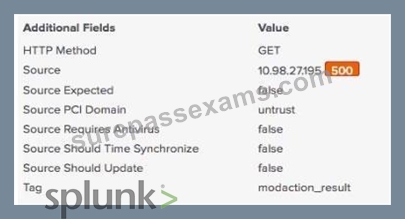
- A. A source ranking.
- B. An event priority.
- C. An IP address rating.
- D. A risk score.
Answer: D
NEW QUESTION # 54
When creating custom correlation searches, what format is used to embed field values in the title, description, and drill-down fields of a notable event?
- A. $fieldname$
- B. "fieldname"
- C. _fieldname_
- D. %fieldname%
Answer: A
NEW QUESTION # 55
Which of the following threat intelligence types can ES download? (Choose all that apply)
- A. SplunkEnterpriseThreatGenerator
- B. VulnScanSPL
- C. STIX/TAXII
- D. Text
Answer: C
Explanation:
Explanation/Reference: https://docs.splunk.com/Documentation/ES/6.1.0/Admin/Downloadthreatfeed
NEW QUESTION # 56
Why are correlation searches critical within Splunk Enterprise Security environments?
- A. Accelerate indexed data replication between geographically distributed clustered storage infrastructures efficiently.
- B. Archive expired compliance reports into long-term regulatory retention storage repositories securely.
- C. Normalize endpoint telemetry into predefined Common Information Model field mapping structures automatically.
- D. Detect suspicious behaviors and generate actionable notable security investigation events automatically.
Answer: D
Explanation:
Correlation searches identify suspicious activity patterns by analyzing normalized data continuously and automatically generating notable events for analyst investigation and response.
NEW QUESTION # 57
How is it possible to navigate to the ES graphical Navigation Bar editor?
- A. Configure -> Navigation Menu
- B. Configure -> General -> Navigation
- C. Settings -> User Interface -> Navigation Menus -> Click on "default" next to SplunkEnterpriseSecuritySuite
- D. Settings -> User Interface -> Navigation -> Click on "Enterprise Security"
Answer: B
Explanation:
Explanation/Reference: https://docs.splunk.com/Documentation/ES/6.1.0/Admin/ Customizemenubar#Restore_the_default_navigation
NEW QUESTION # 58
Which of these Is a benefit of data normalization?
- A. Forwarder-based inputs are more efficient.
- B. Reports run faster because normalized data models can be optimized for better performance.
- C. Dashboards take longer to build.
- D. Searches can be built no matter the specific source technology for a normalized data type.
Answer: D
Explanation:
Explanation
According to the Splunk Enterprise Security documentation, one of the benefits of data normalization is that searches can be built no matter the specific source technology for a normalized data type. Data normalization is a way to ingest and store data in the Splunk platform using a common format for consistency and efficiency.
When data is normalized, it follows the same field names and event tags for equivalent events from different sources or vendors. This allows you to perform cross-source analysis and correlation of security events without worrying about the differences in data formats. For example, if you have data from Windows, Linux, and Mac OS systems, you can normalize them using the Endpoint data model and use the same fields, such as ,
, and , to search for endpoint events across all systems. Therefore, the correct answer is C. Searches can be built no matter the specific source technology for a normalized data type. References = Data sources and normalization Splunk Common Information Model Add-on Onboarding data to Splunk Enterprise Security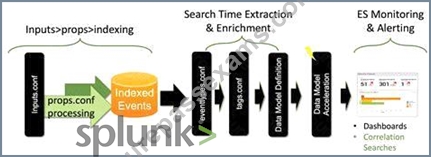
NEW QUESTION # 59
What feature of Enterprise Security downloads threat intelligence data from a web server?
- A. Threat Download Manager
- B. Threat Service Manager
- C. Therat Intelligence Enforcement
- D. Threat Intelligence Parser
Answer: A
Explanation:
Explanation
"The Threat Intelligence Framework provides a modular input (Threat Intelligence Downloads) that handles the majority of configurations typically needed for downloading intelligence files & data. To access this modular input, you simply need to create a stanza in your Inputs.conf file called "threatlist"."
NEW QUESTION # 60
Which of the following are data models used by ES? (Choose all that apply.)
- A. Anomalies
- B. Web
- C. Authentication
- D. Network Traffic
Answer: A
Explanation:
Explanation/Reference: https://dev.splunk.com/enterprise/docs/developapps/enterprisesecurity/datamodelsusedbyes/
NEW QUESTION # 61
......
Full SPLK-3001 Practice Test and 118 unique questions with explanations waiting just for you, get it now: https://drive.google.com/open?id=1fgnk53QWflR8uBXeNz8U8TuUmcFpNxtj
Accurate & Verified Answers As Seen in the Real Exam here: https://www.surepassexams.com/SPLK-3001-exam-bootcamp.html