

300-410 Training & Certification Get Latest CCNP Enterprise Updated on Feb 17, 2023
Certification Training for 300-410 Exam Dumps Test Engine
NEW QUESTION 242
Refer to the exhibit.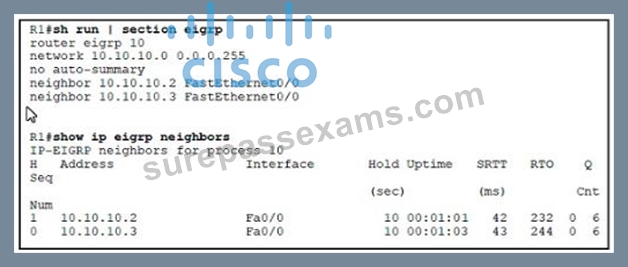
Refer to the exhibit The remote branch locations have a static neighbor relationship configured to R1 only R1 has successful neighbor relationships with the remote locations of R2 and R3, but the end users cannot communicate with each other. Which configuration resolves the issue'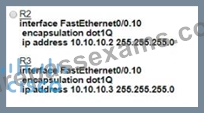
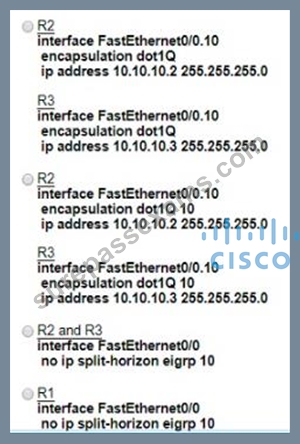
- A. Option D
- B. Option A
- C. Option E
- D. Option C
- E. Option B
Answer: C
NEW QUESTION 243
Refer to the exhibit.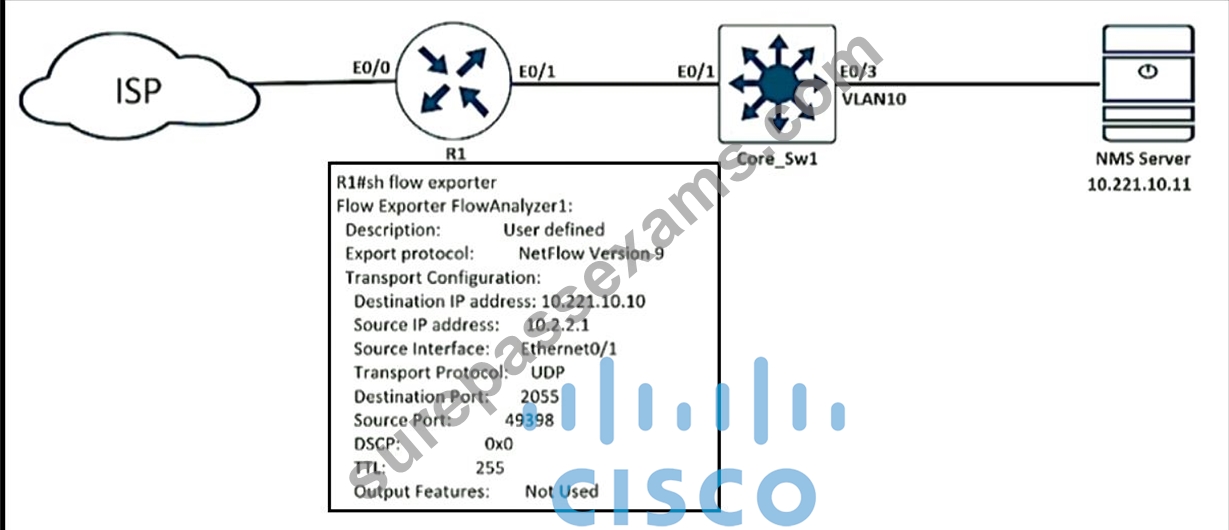
An engineer configured NetFlow on R1, but the NMS server cannot see the flow from R1. Which configuration resolves the issue?
- A. interface Ethernet0/0
flow-destination 10.221.10.11 - B. interface Ethernet0/1
flow-destination 10.221.10.11 - C. flow exporter FlowAnalyzer1
destination 10.221.10.11 - D. flow monitor Flowmonitor1
destination 10.221.10.11
Answer: C
Explanation:
From the output we notice that the destination IP address is not correct.
The NMS server IP address should be 10.221.10.11, not 10.221.10.10.
Therefore we have to change this information under "flow exporter ..." configuration.
NetFlow configuration reference: https://www.cisco.com/c/en/us/td/docs/iosxml/ios/fnetflow/configuration/15-mt/fnf-15-mt-book/cfg-de-fnflow-exprts.html
NEW QUESTION 244
When determining if a system is capable of support, what is the minimum time spacing required for a BFD control packet to receive once a control packet is arrived?
- A. Detect Mult
- B. Required Min Echo RX Interval
- C. Required Min RX Interval
- D. Desired Min TX Interval
Answer: C
Explanation:
Desired Min TX Interval: This is the minimum interval, in microseconds, that the local system would like to use when transmitting BFD Control packets, less any jitterapplied. The value zero is reserved.
Required Min Echo RX Interval: This is the minimum interval, in microseconds, between received BFD Echo packets that this system is capable of supporting, less anyjitter applied by the sender. If this value is zero, the transmitting system does not support the receipt of BFD Echo packets.
NEW QUESTION 245
Refer to Exhibit: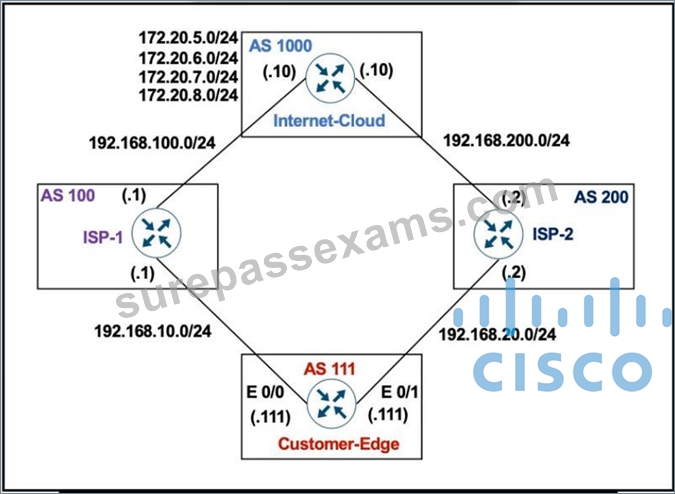
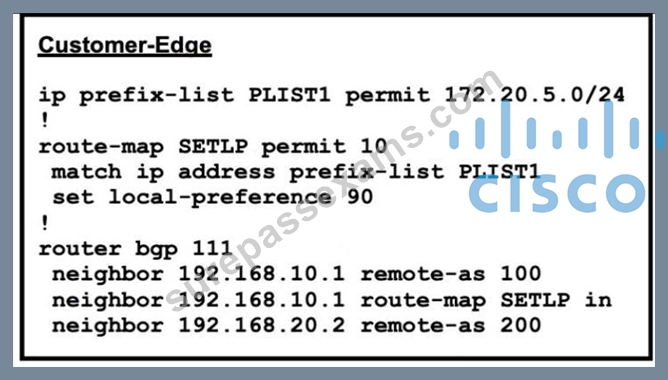
AS 111 wanted to use AS 200 as the preferred path for 172.20.5.0/24 and AS 100 as the backup. After the configuration, AS 100 is not used for any other routes. Which configuration resolves the issue?
- A. router bap 111
no neighbor 192.168.10.1 route-map SETLP in
neighbor 192.168.20.2 route-map SE TLP in - B. route-mmap SETLP permit 10
match ip address prefix-list PLIST1
set local-preference 99
route-map SETLP permit 20 - C. router bgp 111
no neighbor 192.168.10.1 route-map SETLP in
neighbor 192.168.10.1 route-map SETLP out - D. route-map SETLP permit 10
match ip address prefix-list PLIST1
set local-preference 110
route-map SETLP permit 20
Answer: B
Explanation:
Explanation
There is an implicit deny all at the end of any route-map so all other traffic that does not match 172.20.5.0/24 would be dropped. Therefore we have to add a permitsequence at the end of the route-map to allow other traffic.
The default value of Local Preference is 100 and higher value is preferred so we have to set the local preference of AS100 lower than that of AS200.
NEW QUESTION 246
An engineer configured a company's multiple area OSPF head office router and Site A cisco routers with VRF lite. Each site router is connected to a PE router of an MPLS backbone.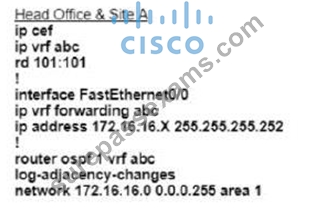
After finishing both site router configurations, none of the LSA 3,4 5, and 7 are installed at Site A router.
Which configuration resolves this issue?
- A. configure capability vrf-lite on Head Office and its connected PE router under router ospf 1 vrf abc
- B. configure capability vrf-lite on both PE routers connected to Head Office and Site A routers under routtr ospf 1 vrf abc
- C. configure capability vrf-lite on Site A and its connected PE router under router ospf 1 vrf abc
- D. configure capability vrf-lite on Head Office and Site A routers under router ospf 1 vrf abc
Answer: B
NEW QUESTION 247
Which Ipv6 first-hop security feature helps to minimize denial of service attacks?
- A. IPv6 MAC address filtering
- B. DHCPv6 Guard
- C. IPv6 Router Advertisement Guard
- D. IPv6 Destination Guard
Answer: D
NEW QUESTION 248
Refer to the exhibit.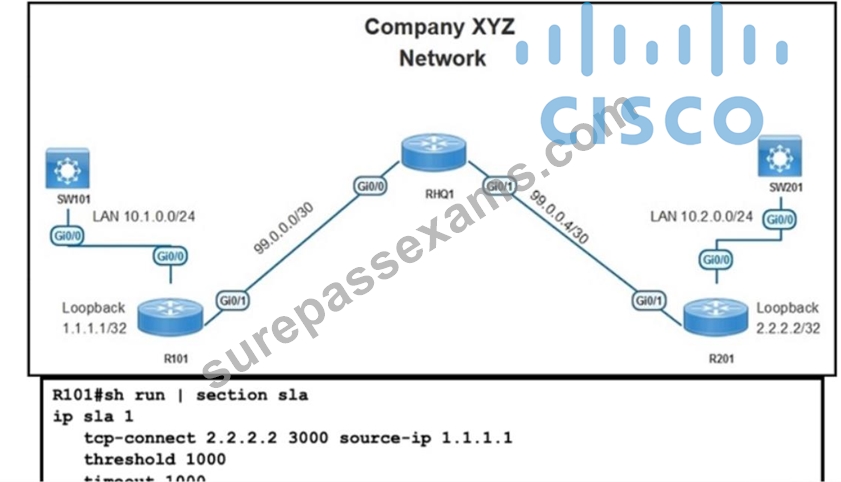
Refer to the exhibit While troubleshooting an issue on the network, an engineer notices that a TCP Connect operation failed on port 3000 between R101 and R201. Which command must be configured on R201 to respond to the R101 IP SLA configurations with a control connection on UDP port 1967?
- A. ip sla responder tcp-connect ipaddress 1.1.1.1 port 3000
- B. ip sla responder udp-echo ipaddress 1.1.1.1 port 1967
- C. ip sla responder
- D. ip sla responder tcp-connect ipaddress 2.2.2.2 port 3001
Answer: B
NEW QUESTION 249
Refer to the exhibit.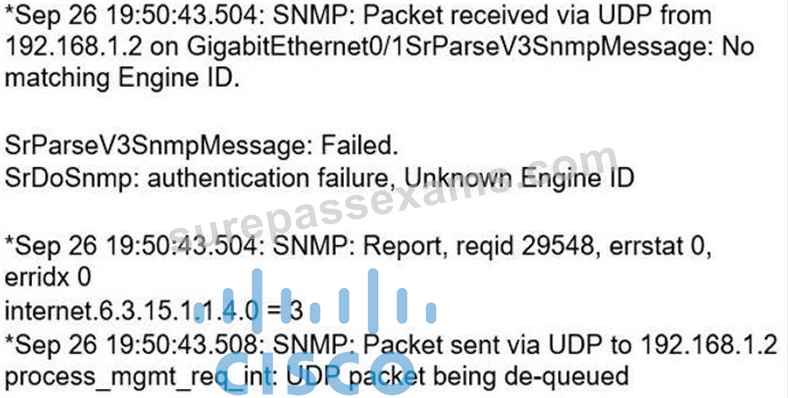
Which two commands provide the administrator with the information needed to resolve the issue? (Choose two.)
- A. debug snmpv3 engine-id
- B. debug snmp engine-id
- C. snmp user
- D. showsnmpv3 user
- E. debug snmp packet
Answer: C,D
NEW QUESTION 250
Refer to the exhibit.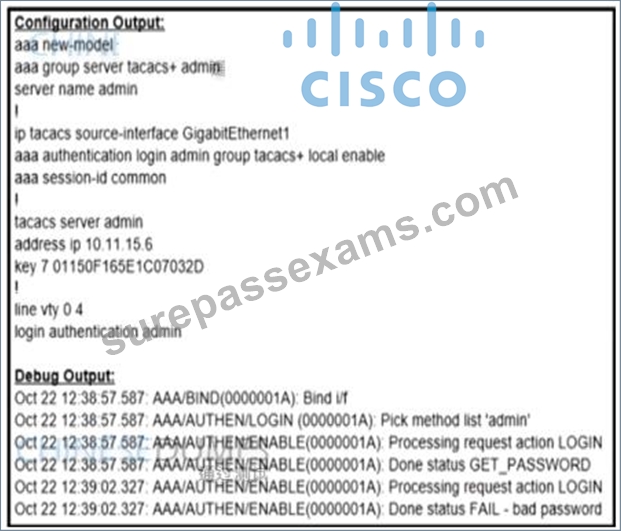
An administrator configured a Cisco router for TACACS authentication, but the router is using the local enable password instead Which action resolves the issue?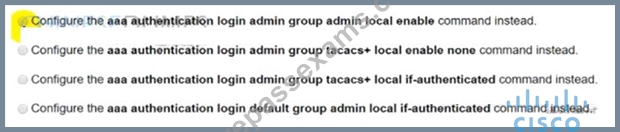
- A. Option D
- B. Option A
- C. Option B
- D. Option C
Answer: D
NEW QUESTION 251
Which command displays the IP routing table information that is associated with VRF-Lite?
- A. show ip vrf
- B. show ip protocols vrf
- C. show ip route vrf
- D. show run vrf
Answer: C
Explanation:
Reference:
https://www.cisco.com/c/en/us/td/docs/switches/lan/catalyst4500/12-2/50sg/configuration/guide/Wrapper-46SG/vrf.html#wp1045708
NEW QUESTION 252
Refer to the exhibit.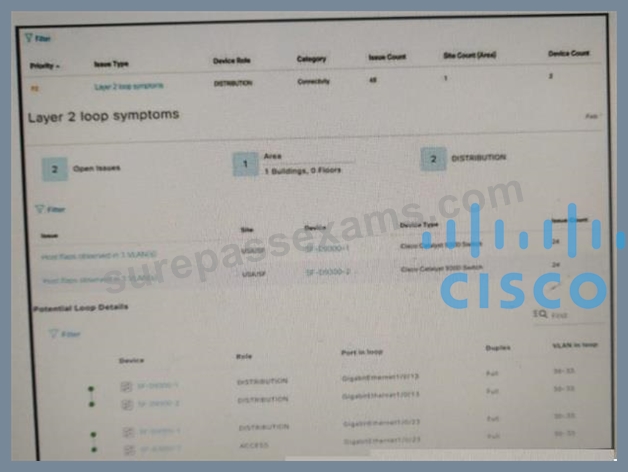
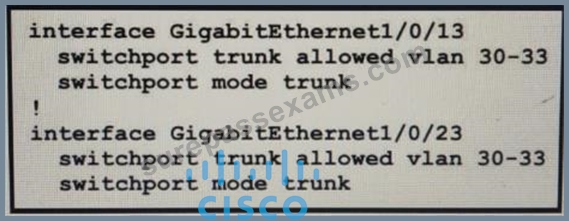
An engineer identifier a Layer 2 loop using DNAC. Which command fixes the problem in the SF-D9300-1 switch?
- A. spanning-tree loopguard default
- B. no spanning-tree uplinkfast
- C. spanning-tree backbonesfast
- D. spanning-tree portfast bpduguard
Answer: D
Explanation:
Explanation
https://www.cisco.com/c/en/us/td/docs/cloud-systems-management/network-automation-and management/dnacenter/tech_notes/b_dnac_sda_lan_automation_deployment.html
NEW QUESTION 253
Refer to the exhibit. The Los Angeles and New York routers are receiving routes from Chicago but not from each other Which configuration fixes the issue?
- A. Interface Tunnel1
tunnel protection ipsec profile IPSec-PROFILE - B. Interface Tunnel1
Ip next-hop-self elgrp 111 - C. Interface Tunnel1
no ip split-horizon eigrp 111 - D. Interface Tunnel1
tunnel mode Ipsec Ipv4
Answer: C
Explanation:
In this topology, Chicago router (Hub) will receive advertisements from Los Angeles (Spoke1) router on its tunnel interface. The problem here is that it also has a connection with New York (Spoke2) on that same tunnel interface. If we don't disable EIGRP split-horizon, then the Hub will not relay routes from Spoke1 to Spoke2 and the other way around. That is because it received those routes on interface Tunnel1 and therefore it cannot advertise back out that same interface (splithorizon rule). Therefore we must disable split-horizon on the Hub router to make sure the Spokes know about each other.
NEW QUESTION 254
R2 has a locally originated prefix 192.168.130.0/24 and has these configurations: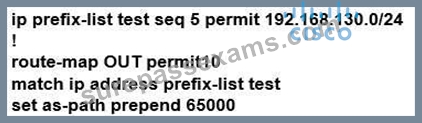
What is the result when the route-map OUT command is applied toward an eBGP neighbor R1 (1.1.1.1) by using the neighbor 1.1.1.1 route-map OUT out command?
- A. R1 does not accept any routes other than 192.168.130.0/24
- B. R1 does not forward traffic that is destined for 192.168.30.0/24
- C. R1 sees 192.168.130.0/24 as two AS hops away instead of one AS hop away.
- D. Network 192.168.130.0/24 is not allowed in the R1 table
Answer: C
Explanation:
Section: Layer 3 Technologies
NEW QUESTION 255
Refer to the exhibit.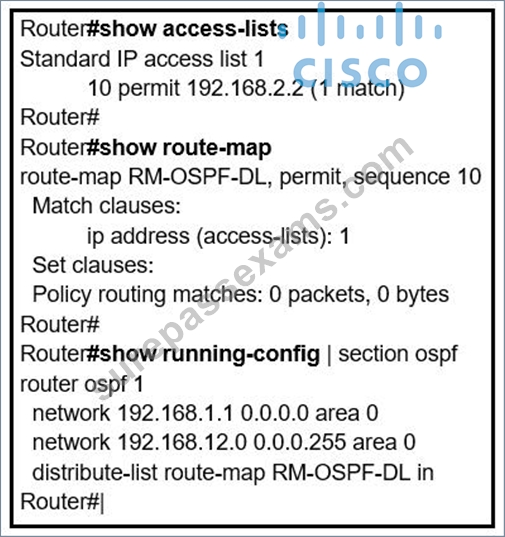
An engineer is trying to block the route to 192.168.2.2 from the routing table by using the configuration that is shown. The route is still present in the routing table as an OSPF route. Which action blocks the route?
- A. Add this statement to the route map: route-map RM-OSPF-DL deny 20.
- B. Use an extended access list instead of a standard access list.
- C. Use a prefix list instead of an access list in the route map.
- D. Change sequence 10 in the route-map command from permit to deny.
Answer: D
NEW QUESTION 256
Drag and drop the MPLS VPN concepts from the left onto the correct descriptions on the right.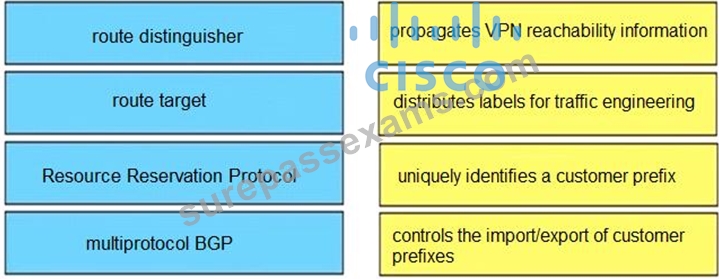
Answer:
Explanation: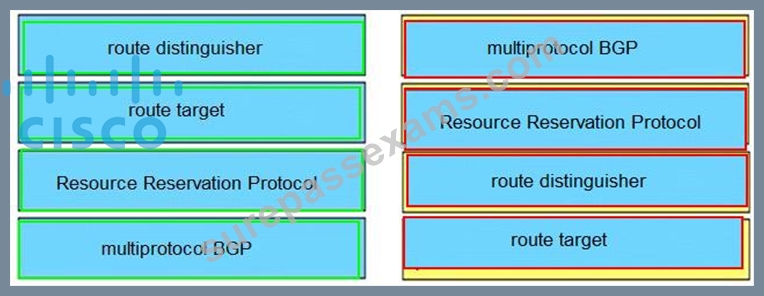
Reference:
https://www.rogerperkin.co.uk/featured/route-distinguisher-vs-route-target/
NEW QUESTION 257
......
Step by Step Guide to Prepare for 300-410 Exam: https://www.surepassexams.com/300-410-exam-bootcamp.html
CCNP Enterprise 300-410 Real Exam Questions and Answers FREE Updated: https://drive.google.com/open?id=12fdfw-jD3RhIIXdn1KjDDqOwoOE5ulxK