

HP HPE6-A85 Exam Dumps [2024] Practice Valid Exam Dumps Question
HPE6-A85 Dumps - Grab Out For [NEW-2024] HP Exam
HP HPE6-A85 exam is an ideal certification for IT professionals who are looking to advance their careers in the field of networking. HPE6-A85 exam covers a range of topics that are essential for anyone who is working in the industry, including wireless networking, network security, and troubleshooting. By earning the ACSA certification, candidates can demonstrate their expertise in these areas and increase their career prospects with potential employers.
The Aruba Campus Access Associate Exam is ideal for network administrators, wireless engineers, and technical support professionals who want to enhance their skills and knowledge in Aruba networking solutions. Aruba Campus Access Associate Exam certification is recognized globally and can help candidates stand out in a competitive job market.
To prepare for the HPE6-A85 exam, candidates can take advantage of a variety of resources, including Aruba’s training courses, study guides, and practice exams. These resources provide a comprehensive overview of the exam’s topics and can help candidates identify areas where they need to focus their study efforts.
NEW QUESTION # 12
When performing live firmware upgrades on Aruba APs.
Which technology partitions all the APs based on RF neighborhood data minimizing the impact on clients?
- A. Aruba Ai insights
- B. Aruba AirMatch
- C. Aruba ESP
- D. Aruba ClientMatch
Answer: B
Explanation:
Aruba AirMatch is a feature that optimizes RF Radio Frequency. RF is any frequency within the electromagnetic spectrum associated with radio wave propagation. When an RF current is supplied to an antenna, an electromagnetic field is created that then is able to propagate through space. performance and user experience by using machine learning algorithms and historical data to dynamically adjust AP power levels, channel assignments, and channel width. AirMatch performs live firmware upgrades on Aruba APs by partitioning all the APs based on RFneighborhood data and minimizing the impact on clients. AirMatch uses a rolling upgrade process that upgrades one partition at a time while ensuring that adjacent partitions are not upgraded simultaneously.
References:
https://www.arubanetworks.com/assets/ds/DS_AirMatch.pdfhttps://www.arubanetworks.com/techdocs/Ar ubaOS
NEW QUESTION # 13
Which feature can network administrators use to centralized RF planning and optimization service when using an Aruba mobility master architecture?
- A. Airwave
- B. Client Wave
- C. AirMatch
- D. Client Match
Answer: C
Explanation:
AirMatch is a feature that provides centralized RF planning and optimization service for Aruba wireless networks. It uses cloud-based algorithms and machine learning to optimize the RF performance and user experience. Reference: https://www.arubanetworks.com/assets/ds/DS_AirMatch.pdf In Aruba networks, the recommended Virtual Switching Framework (VSF) topologies include the daisy chain plus Multi-Active Detection (MAD) and the ring topology. The daisy chain topology with MAD provides a straightforward and effective way to connect multiple switches in a series while ensuring there is a mechanism in place (MAD) to detect and handle situations where more than one switch in the VSF might become active simultaneously. The ring topology offers redundancy by creating a looped connection pattern among the VSF members, enhancing network resilience and reliability.
NEW QUESTION # 14
What does WPA3-Personal use as the source to generate a different Pairwise Master Key (PMK) each time a station connects to the wireless network?
- A. Session-specific information (MACs and nonces)
- B. Simultaneous Authentication of Equals (SAE)
- C. Opportunistic Wireless Encryption (OWE)
- D. Key Encryption Key (KEK)
Answer: B
Explanation:
WPA3-Personal enhances the security of wireless networks by using Simultaneous Authentication of Equals (SAE), which is a more secure replacement for the Pre-Shared Key (PSK) method used in WPA2. SAE strengthens the initial key exchange, providing better protection against offline dictionary attacks and ensuring that each session has a unique Pairwise Master Key (PMK), derived from the interaction between the client and the access point, including session-specific information like MAC addresses and nonces.
NEW QUESTION # 15
List the WPA 4-Way Handshake functions in the correct order.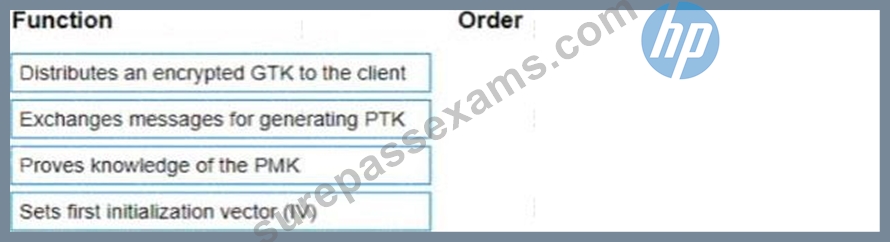
Answer:
Explanation: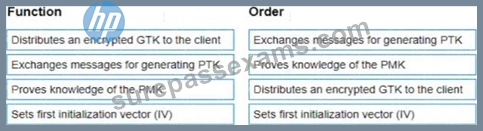
Explanation:
The WPA 4-Way Handshake functions in the correct order are as follows:
Exchanges messages for generating PTK
Proves knowledge of the PMK
Distributes an encrypted GTK to the client
Sets first initialization vector (IV)
The process is designed to confirm that both the client and the access point have the correct credentials (such as the PMK), to establish the temporal keys used to encrypt and decrypt data, and to confirm that the client is actually alive and present at the time of the handshake.
NEW QUESTION # 16
Based on the given topology, what is the requirement on an Aruba switch to enable LLDP messages to be received by Switch 1 port 1/1/24. when Router 1 is enabled with LLDP?
- A. global configuration lldp enable
- B. int 1/1/24, lldp receive
- C. LLDP is enabled by default
- D. int 1/1/24, no cdp
Answer: C
Explanation:
On Aruba switches, the Link Layer Discovery Protocol (LLDP) is enabled by default on all ports. This protocol is an industry-standard network discovery protocol that is used for network devices to advertise their identity, capabilities, and neighbors on a locally managed network, typical in an IEEE 802 network. This is beneficial for network mapping and troubleshooting purposes. Since LLDP is enabled by default, there is no need for any additional configuration on Switch 1 port 1/1/24 to receive LLDP messages from Router 1, as long as LLDP is not disabled on the port.
NEW QUESTION # 17
A network technician is troubleshooting one new AP at a branch office that will not receive Its configuration from Aruba Central. The other APs at the branch are working as expected. The output of the 'show ap debug cloud-server command' shows that the "cloud conflg received" Is FALSE.
After confirming the new AP has internet access, what would you check next?
- A. Disable and enable Aruba Central to trigger configuration refresh
- B. Verify the AP can ping the device on arubanetworks.com
- C. Verify the AP has a license assigned
- D. Disable and enable activate to trigger provisioning refresh
Answer: C
Explanation:
If the AP has internet access but does not receive its configuration from Aruba Central, one possible reason is that the AP does not have a license assigned in Aruba Central. A license is required for each AP to be managed by Aruba Central.
References: https://www.arubanetworks.com/techdocs/Central/2.5.2-GA/HTML_frameset.htm#GUID-
8F0E7E8
NEW QUESTION # 18
The noise floor measures 000000001 milliwatts, and the receiver's signal strength is -65dBm. What is the Signal to Noise Ratio?
- A. 25 dBm
- B. 45 dBm
- C. 35 dBm
- D. 15 dBm
Answer: A
Explanation:
Explanation
The signal to noise ratio (SNR) is a measure that compares the level of a desired signal to the level of background noise. SNR is defined as the ratio of signal power to the noise power, often expressed in decibels (dB). A high SNR means that the signal is clear and easy to detect or interpret, while a low SNR means that the signal is corrupted or obscured by noise and may be difficult to distinguish or recover3. To calculate the SNR in dB, we can use the following formula:
SNR (dB) = Signal power (dBm) - Noise power (dBm)
In this question, we are given that the noise floor measures -90 dBm (0.000000001 milliwatts) and the receiver's signal strength is -65 dBm (0.000316 milliwatts). Therefore, we can plug these values into the formula and get:
SNR (dB) = -65 dBm - (-90 dBm) SNR (dB) = -65 dBm + 90 dBm SNR (dB) = 25 dBm Therefore, the correct answer is that the SNR is 25 dBm.
References: 3 https://en.wikipedia.org/wiki/Signal-to-noise_ratio
NEW QUESTION # 19
What is the recommended VSF topology? (Select two.)
- A. Full mesh plus MAD
- B. Full mesh
- C. Star
- D. Daisy chain plus MAD
- E. Ring
Answer: D,E
Explanation:
Only: Daisy chain plus MAD and ring are the recommended VSF topologies for Aruba switches. They provide high availability and redundancy for the VSF stack. MAD (Multiple Active Detection) is a mechanism to detect and resolve split-brain scenarios in a VSF stack.
References: https://www.arubanetworks.com/techdocs/AOS-CX/10.04/HTML/5200-6790/GUID- D6EF042E-EE
NEW QUESTION # 20
Which are valid steps in troubleshooting Aruba Wireless Access Point connection issues? (Choose three)
- A. Check the power settings on the physical switch port connected to the AP.
- B. Reset the AP to factory default settings.
- C. Verify network cable integrity from the AP to the switch.
- D. Ensure that the AP is in compliance with the latest firmware updates.
Answer: A,C,D
NEW QUESTION # 21
When would you bond multiple 20MHz wide 802.11 channels?
- A. To utilize high gain omni-directional antennas
- B. To decrease the Signal to Noise Ratio (SNR)
- C. To increase throughput between the client and AP
- D. To provision highly available AP groups
Answer: C
Explanation:
Bonding multiple 20MHz wide 802.11 channels is a technique to create a wider bandwidth channel that supports higher data rate transmissions. It can increase the throughput between the client and AP by using more spectrum resources and reducing interference.
References: https://ieeexplore.ieee.org/document/9288995
NEW QUESTION # 22
Please match the use case to the appropriate authentication technology
Answer:
Explanation:
NEW QUESTION # 23
Which statement about manual switch provisioning with Aruba Central is correct?
- A. Manual provisioning requires DHCP and requires DNS
- B. Manual provisioning does not require DHCP and requires DNS
- C. Manual provisioning does not require DHCP and does not require DNS
- D. Manual provisioning requires DHCP and does not require DNS
Answer: C
Explanation:
Manual provisioning is a method to add switches to Aruba Central without using DHCP or DNS. It requires the user to enter the switch serial number, MAC address, and activation code in Aruba Central, and then configure the switch with the same activation code and Aruba Central's IP address.
References:
https://help.central.arubanetworks.com/latest/documentation/online_help/content/devices/switches/p
NEW QUESTION # 24
When measuring signal strength, dBm is commonly used and 0 dBm corresponds to 1 mW power.
What does -20 dBm correspond to?
- A. 1mW
- B. .01 mw
- C. 10 mW
- D. .-1 mW
Answer: B
Explanation:
dBm is a unit of power that measures the ratio of a given power level to 1 mW. The formula to convert dBm to mW is: P(mW) = 1mW * 10^(P(dBm)/10). Therefore, -20 dBm corresponds to 0.01 mW, as follows: P(mW) = 1mW * 10^(-20/10) = 0.01 mW References: https://www.rapidtables.com/convert/power/dBm_to_mW.html
NEW QUESTION # 25
A customer has just implemented user and device certificates via a company-wide Group Based Policy (GPO) Which EAP method requires client certificates when authenticating to the network?
- A. EAP-TEAP
- B. EAP-TLS
- C. EAP-TTLS
- D. PEAP
Answer: B
Explanation:
EAP-TLS is an authentication method that requires client certificates when authenticating to the network. It provides mutual authentication between the client and the server using public key cryptography and digital certificates. Reference: https://www.arubanetworks.com/techdocs/ClearPass/6.9/Guest/Content/CPPM_UserGuide/EAP-TLS/EAP-TLS.htm EAP-TLS (Extensible Authentication Protocol-Transport Layer Security) is an EAP method that requires both server-side and client-side certificates for authentication. It is considered one of the most secure EAP methods because it uses a mutual authentication process where both the user and the authentication server must prove their identities to each other through the use of certificates. Implementing user and device certificates via a Group Based Policy (GPO) aligns well with EAP-TLS requirements for client-side certificates.
NEW QUESTION # 26
When using an Aruba standalone AP you select "Native VLAN" for the Client VLAN Assignment In which subnet will the client IPs reside?
- A. The same subnet as the Aruba ESP gateway
- B. The same subnet as the access point
- C. The same subnet as the mobility controller
- D. The same subnet as the mobility conductor
Answer: B
Explanation:
When using an Aruba standalone AP, selecting "Native VLAN" for the Client VLAN Assignment means that the clients will get their IP addresses from the same subnet as the access point's IP address. This is because the access point acts as a DHCP server for the clients in this mode. Reference: https://www.arubanetworks.com/techdocs/Instant_86_WebHelp/Content/instant-ug/iap-dhcp/iap-dhcp.htm
NEW QUESTION # 27
You need to configure wireless access for several classes of loT devices, some of which operate only with 802
11b. Each class must have a unique PSK and will require a different security policy applied as a role There will be 15-20 different classes of devices and performance should be optimized Which option fulfills these requirements''
- A. Individual SSIDs with unique PSK for each loT class, using 5GHz and 6 GHz bands
- B. Single SSID with MPSK for each loT class using 2.4GHz and 5 GHz bands
- C. Single SSID with MPSK for each loT class using 5 GHz and 6 GHz bands
- D. Individual SSIDs with unique PSK for each loT class, using 2.4GHZ and 5GHz band
Answer: D
Explanation:
Explanation
The option that fulfills the requirements is to create individual SSIDs with unique PSK for each loT class, using 2.4 GHz and 5 GHz band. This option provides the following benefits:
Each loT class has a unique PSK that can be used to apply a different security policy as a role. This enhances the security and flexibility of the WLAN network.
Individual SSIDs allow for better isolation and management of different loT classes. This improves the performance and scalability of the WLAN network.
Using both 2.4 GHz and 5 GHz bands allows for backward compatibility with loT devices that operate only with 802.11b, which uses the 2.4 GHz band . It also allows for higher throughput and less interference for loT devices that support 802.11a, 802.11g, 802.11n, or 802.11ac, which use the 5 GHz band2.
The other options do not fulfill the requirements because:
Single SSID with MPSK for each loT class using 5 GHz and 6 GHz bands: This option does not support loT devices that operate only with 802.11b, which uses the 2.4 GHz band . It also does not optimize the performance of the WLAN network, as a single SSID may cause co-channel interference and congestion among different loT classes.
Single SSID with MPSK for each loT class using 2.4 GHz and 5 GHz bands: This option does not optimize the performance of the WLAN network, as a single SSID may cause co-channel interference and congestion among different loT classes.
Individual SSIDs with unique PSK for each loT class, using 5 GHz and 6 GHz bands: This option does not support loT devices that operate only with 802.11b, which uses the 2.4 GHz band1.
References: 1 https://en.wikipedia.org/wiki/IEEE_802.11b-1999 2
https://www.lifewire.com/wireless-standards-802-11a-802-11b-g-n-and-802-11ac-816553
NEW QUESTION # 28
Based on the given topology, what is the requirement on an Aruba switch to enable LLDP messages to be received by Switch 1 port 1/1/24.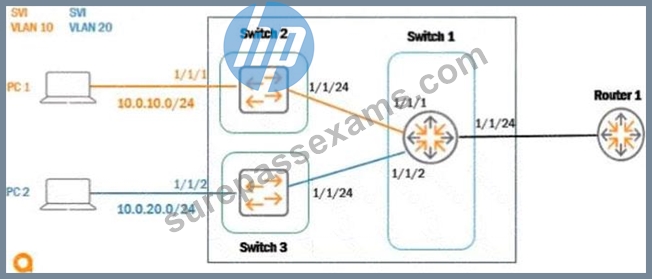
When Router 1 is enabled with LLDP?
- A. global configuration lldp enable
- B. int 1/1/24, lldp receive
- C. LLDP is enabled by default
- D. int 1/1/24, no cdp
Answer: C
Explanation:
For an Aruba switch to receive LLDP messages on a specific port, LLDP must be enabled on that port.
The default configuration for Aruba switches typically has LLDP enabled on all ports, so in most cases, no additional configuration is required.
This means that if Router 1 is sending LLDP messages, Switch 1 port 1/1/24 should receive them without additional configuration, as long as LLDP has not been disabled on that port. If LLDP were disabled on the switch or on the specific port, you would then need to enable it, which could be similar to option C (with correct Aruba OS syntax), as option B suggests a global configuration command which is not typically how LLDP is enabled on Aruba switches. Option D is related to Cisco Discovery Protocol (CDP), which is not relevant to LLDP operation.
NEW QUESTION # 29
You have physical access to an Aruba CX-Switch with unknown/lost credentials. What are the possible steps to rebuild the credentials? (Select two.)
- A. Use boot profile 0.
- B. Press and hold the clear button. Then, press the reset button for 2 seconds and release both buttons.
- C. Connect the switch via the console. Then, power cycle the switch.
- D. Call Aruba support for a one-time password.
- E. Press and hold the clear button. Then, power-cycle the switch.
Answer: A,E
Explanation:
To regain access to an Aruba CX switch when credentials are unknown or lost, one can press and hold the clear button, then power cycle the switch to reset the password. Additionally, using the boot profile 0 at the boot loader menu can be used to bypass the current startup configuration, which may include the unknown credentials.
NEW QUESTION # 30
......
HPE6-A85 Exam Dumps PDF Guaranteed Success with Accurate & Updated Questions: https://www.surepassexams.com/HPE6-A85-exam-bootcamp.html
Pass HPE6-A85 Exam - Real Test Engine PDF with 115 Questions: https://drive.google.com/open?id=1uemATxUcE3McB0-mKb6FVw99yKZpXyRT