

Latest Sep 28, 2026 AZ-305 Brain Dump: A Study Guide with Tips & Tricks for passing Exam
AZ-305 Question Bank: Free PDF Download Recently Updated Questions
NEW QUESTION # 230
Your company has two on-premises sites in New York and Los Angeles and Azure virtual networks in the East US Azure region and the West US Azure region. Each on-premises site has Azure ExpressRoute circuits to both regions.
You need to recommend a solution that meets the following requirements:
Outbound traffic to the Internet from workloads hosted on the virtual networks must be routed through the closest available on-premises site.
If an on-premises site fails, traffic from the workloads on the virtual networks to the Internet must reroute automatically to the other site.
What should you include in the recommendation? To answer, select the appropriate options in the answer area.
NOTE: Each correct selection is worth one point.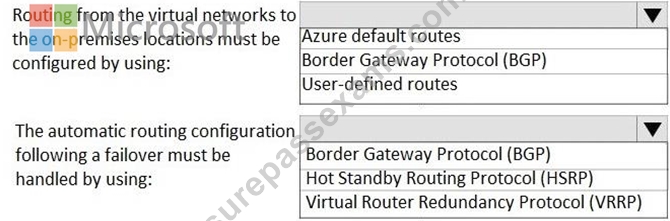
Answer:
Explanation: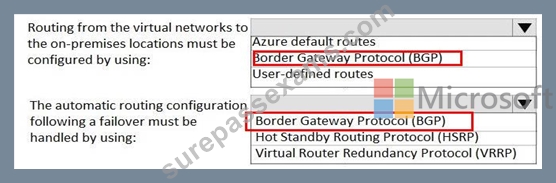
NEW QUESTION # 231
Your company develops a web service that is deployed to an Azure virtual machine named VM1. The web service allows an API to access real-time data from VM1.
The current virtual machine deployment is shown in the Deployment exhibit. (Click the Deployment tab).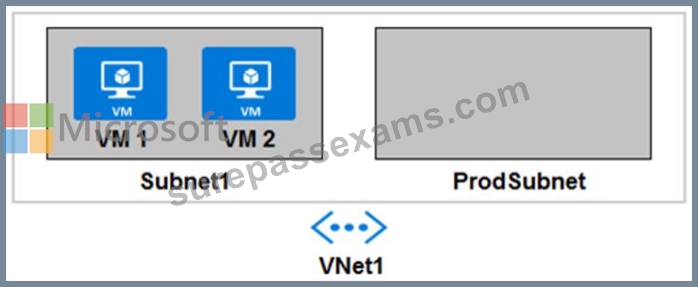
The chief technology officer (CTO) sends you the following email message: "Our developers have deployed the web service to a virtual machine named VM1. Testing has shown that the API is accessible from VM1 and VM2. Our partners must be able to connect to the API over the Internet. Partners will use this data in applications that they develop." You deploy an Azure API Management (APIM) service. The relevant API Management configuration is shown in the API exhibit. (Click the API tab.)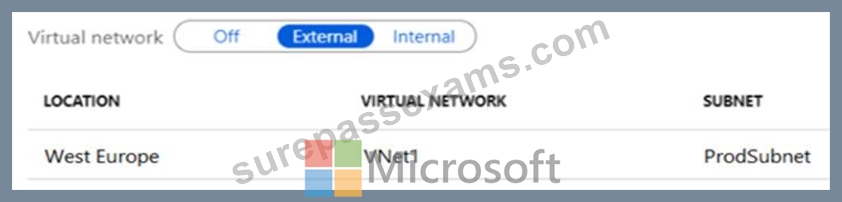
For each of the following statements, select Yes if the statement is true. Otherwise, select No.
NOTE: Each correct selection is worth one point.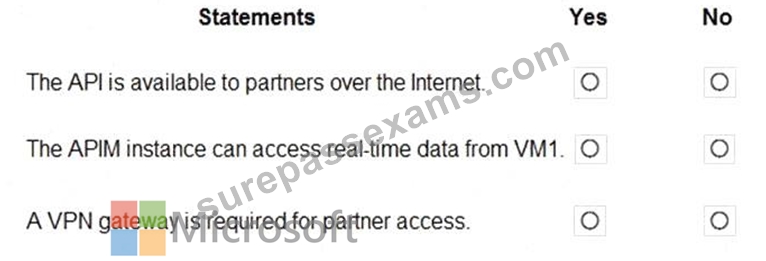
Answer:
Explanation: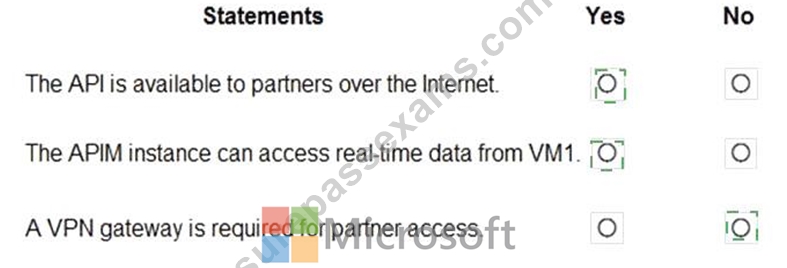
Explanation: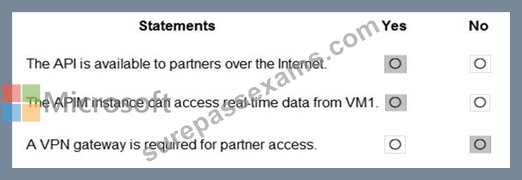
Reference:
https://docs.microsoft.com/en-us/azure/api-management/api-management-using-with-vnet
NEW QUESTION # 232
Note: This question is part of a series of questions that present the same scenario. Each question in the series contains a unique solution that might meet the stated goals. Some question sets might have more than one correct solution, while others might not have a correct solution.
After you answer a question in this section, you will NOT be able to return to it. As a result, these questions will not appear in the review screen.
Your company plans to deploy various Azure App Service instances that will use Azure SQL databases. The App Service instances will be deployed at the same time as the Azure SQL databases.
The company has a regulatory requirement to deploy the App Service instances only to specific Azure regions.
The resources for the App Service instances must reside in the same region.
You need to recommend a solution to meet the regulatory requirement.
Solution: You recommend using the Regulatory compliance dashboard in Azure Security Center.
Does this meet the goal?
- A. Yes
- B. No
Answer: B
Explanation:
The Regulatory compliance dashboard in Azure Security Center is not used for regional compliance.
Note: Instead Azure Resource Policy Definitions can be used which can be applied to a specific Resource Group with the App Service instances.
Note 2: In the Azure Security Center regulatory compliance blade, you can get an overview of key portions of your compliance posture with respect to a set of supported standards. Currently supported standards are Azure CIS, PCI DSS 3.2, ISO 27001, and SOC TSP.
Reference:
https://docs.microsoft.com/en-us/azure/governance/policy/overview
https://azure.microsoft.com/en-us/blog/regulatory-compliance-dashboard-in-azure-security-center-now-available
NEW QUESTION # 233
Drag and Drop Question
You are designing a virtual machine that will run Microsoft SQL Server and contain two data disks. The first data disk will store log files, and the second data disk will store data. Both disks are P40 managed disks.
You need to recommend a host caching method for each disk. The method must provide the best overall performance for the virtual machine while preserving the integrity of the SQL data and logs.
Which host caching method should you recommend for each disk? To answer, drag the appropriate methods to the correct disks. Each method may be used once, more than once, or not at all. You may need to drag the split bar between panes or scroll to view content.
NOTE: Each correct selection is worth one point.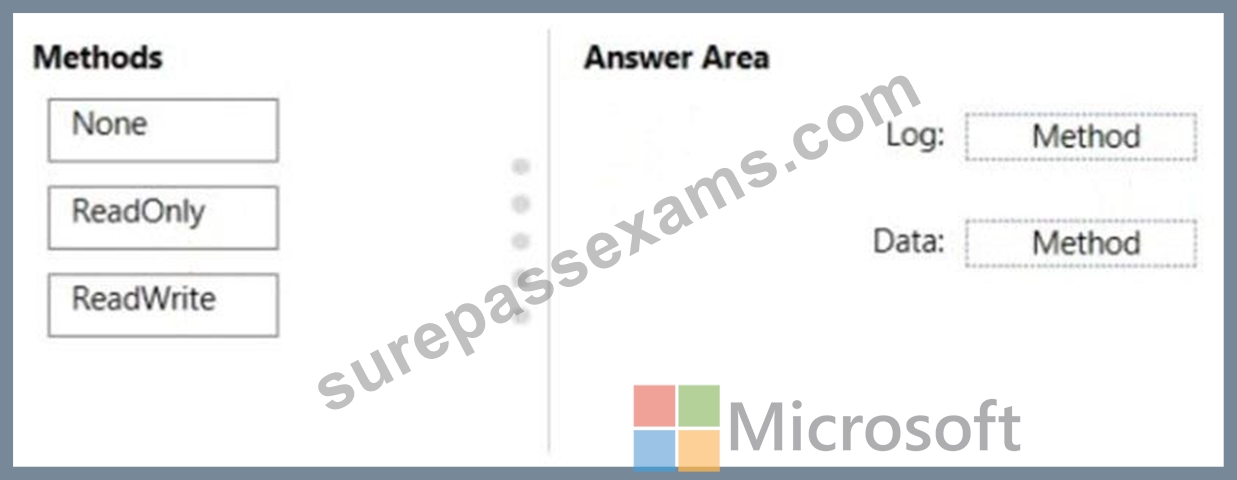
Answer:
Explanation: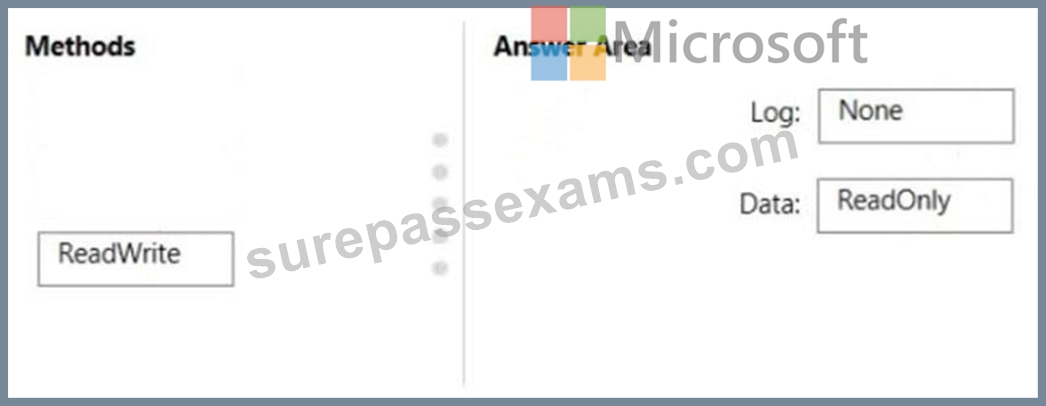
Explanation:
Box 1: None
No data disk caching for the Log files.
Box 2: ReadOnly
Guidelines to optimize performance for your SQL Server on Azure Virtual Machines (VMs) include:
Set host caching to read-only for data file disks.
Set host caching to none for log file disks.
Reference:
https://docs.microsoft.com/en-us/azure/azure-sql/virtual-machines/windows/performance- guidelines-best-practices-storage
NEW QUESTION # 234
Drag and Drop Question
You have an Azure subscription.
As part of a highly available deployment, you plan to deploy 30 virtual machines to an Azure region that contains three availability zones.
You need to recommend a deployment solution for the virtual machines, availability sets, and availability zones. The solution must maximize the availability of the deployment.
Which four actions should you recommend be performed in sequence? To answer, move the appropriate actions from the list of actions to the answer area and arrange them in the correct order.
NOTE: More than one order of answer choices is correct. You will receive credit for any of the correct orders you select.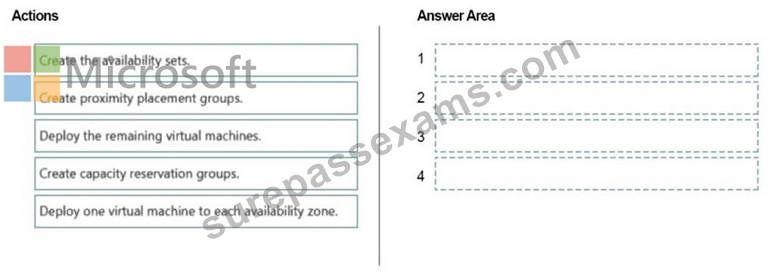
Answer:
Explanation: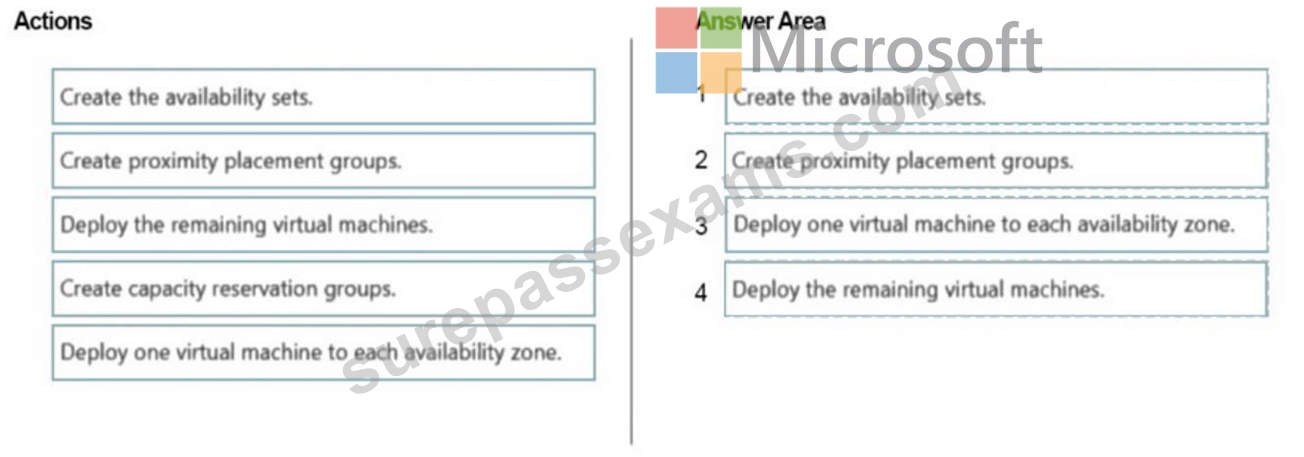
NEW QUESTION # 235
Note: This question is part of a series of questions that present the same scenario. Each question in the series contains a unique solution that might meet the stated goals. Some question sets might have more than one correct solution, while others might not have a correct solution.
After you answer a question in this section, you will NOT be able to return to it. As a result, these questions will not appear in the review screen.
Your company deploys several virtual machines on-premises and to Azure. ExpressRoute is deployed and configured for on-premises to Azure connectivity.
Several virtual machines exhibit network connectivity issues.
You need to analyze the network traffic to identify whether packets are being allowed or denied to the virtual machines.
Solution: Install and configure the Azure Monitoring agent and the Dependency Agent on all the virtual machines. Use VM insights in Azure Monitor to analyze the network traffic.
Does this meet the goal?
- A. Yes
- B. No
Answer: B
Explanation:
Use the Azure Monitor agent if you need to:
Collect guest logs and metrics from any machine in Azure, in other clouds, or on-premises.
Use the Dependency agent if you need to:
Use the Map feature VM insights or the Service Map solution.
Note: Instead use Azure Network Watcher IP Flow Verify allows you to detect traffic filtering issues at a VM level.
IP flow verify checks if a packet is allowed or denied to or from a virtual machine. The information consists of direction, protocol, local IP, remote IP, local port, and remote port. If the packet is denied by a security group, the name of the rule that denied the packet is returned. While any source or destination IP can be chosen, IP flow verify helps administrators quickly diagnose connectivity issues from or to the internet and from or to the on-premises environment.
Reference:
https://docs.microsoft.com/en-us/azure/network-watcher/network-watcher-ip-flow-verify-overview
https://docs.microsoft.com/en-us/azure/azure-monitor/agents/agents-overview#dependency- agent
NEW QUESTION # 236
You have an Azure subscription
You have a Microsoft Entra tenant.
You need to recommend a Microsoft Entra Identity Governance solution to manage the user lifecycle. The solution must meet the following requirements:
* Ensure that users have the correct permission for the correct resources and that the permissions are evaluated every quarter.
* If a user is assigned a new role, ensure that the correct permissions are granted for the correct resources and regularly evaluated for the new role.
* When a user leaves the company, ensure that the user ' s permissions are revoked What should you include in the recommendation?
- A. Microsoft Entra ID Protection
- B. Privileged Identity Management (PIM)
- C. access reviews
- D. Conditional Access
Answer: C
NEW QUESTION # 237
Your company plans to publish APIs for its services by using Azure API Management. You discover that service responses include the AspNet-Version header. You need to recommend a solution to remove AspNet-Version from the response of the published APIs.
What should you include in the recommendation?
- A. a new product
- B. a new policy
- C. a modification to the URL scheme
- D. a new revision
Answer: B
Explanation:
Reference:
https://docs.microsoft.com/en-us/azure/api-management/transform-api
NEW QUESTION # 238
You plan to migrate App1 to Azure.
You need to recommend a high-availability solution for App1. The solution must meet the resiliency requirements.
What should you include in the recommendation? To answer, select the appropriate options in the answer area.
NOTE: Each correct selection is worth one point.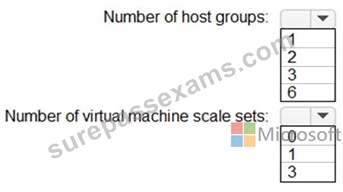
Answer:
Explanation: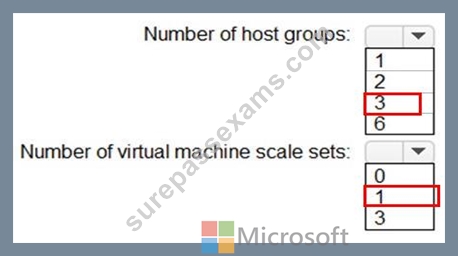
Reference:
https://docs.microsoft.com/en-us/azure/virtual-machines/dedicated-hosts
https://docs.microsoft.com/en-us/azure/virtual-machine-scale-sets/virtual-machine-scale-sets-autoscale-overview
NEW QUESTION # 239
You have an Azure subscription. The subscription contains Azure virtual machines that run Windows Server
2022 and Linux.
You need to use Azure Monitor to design an alerting strategy for security-related events.
Which Azure Monitor Logs tables should you query? To answer, drag the appropriate tables to the correct log types. Each table may be used once, more than once, or not at all. You may need to drag the split bar between panes or scroll to view content. NOTE: Each correct selection is worth one point.
Answer:
Explanation:
Explanation: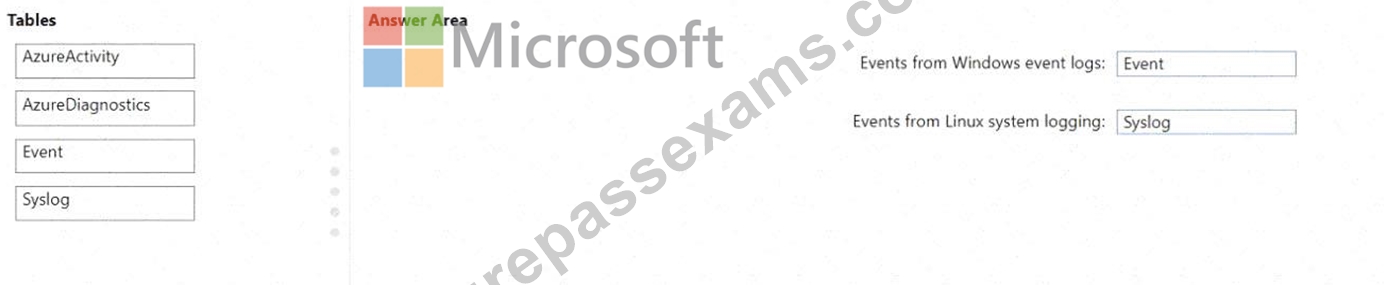
NEW QUESTION # 240
You have five .NET Core applications that run on 10 Azure virtual machines in the same subscription.
You need to recommend a solution to ensure that the applications can authenticate by using the same Azure Active Directory (Azure AD) identity. The solution must meet the following requirements:
Ensure that the applications can authenticate only when running on the 10 virtual machines.
Minimize administrative effort.
What should you include in the recommendation? To answer, select the appropriate options in the answer area.
NOTE: Each correct selection is worth one point.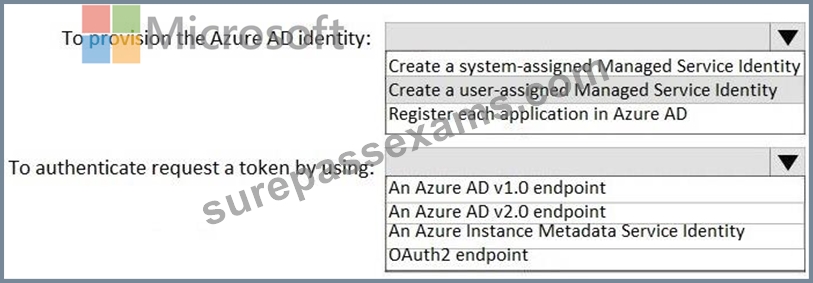
Answer:
Explanation: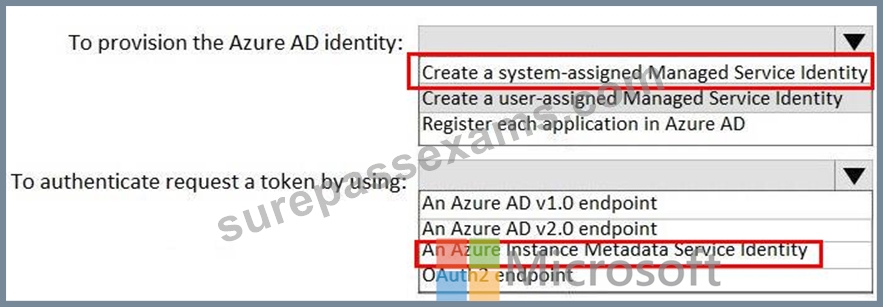
NEW QUESTION # 241
You plan to deploy Azure Databricks to support a machine learning application. Data engineers will mount an Azure Data Lake Storage account to the Databricks file system. Permissions to folders are granted directly to the data engineers.
You need to recommend a design for the planned Databrick deployment. The solution must meet the following requirements:
* Ensure that the data engineers can only access folders to which they have permissions.
* Minimize development effort.
* Minimize costs.
What should you include in the recommendation? To answer, select the appropriate options in the answer area.
NOTE: Each correct selection is worth one point.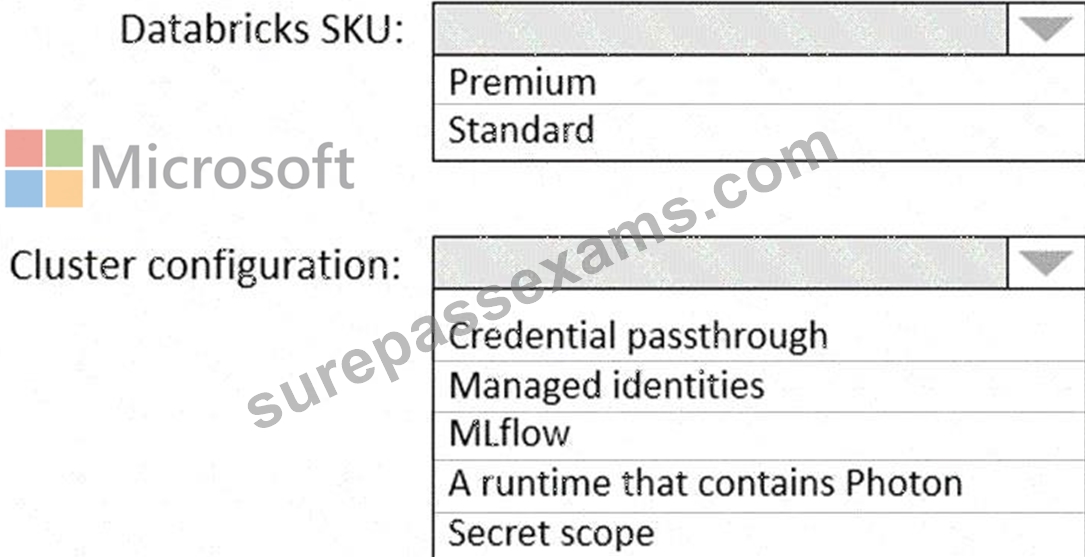
Answer:
Explanation: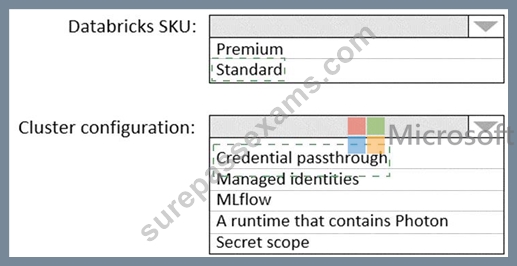
Explanation:
Box 1: Standard
Choose Standard to minimize costs.
Box 2: Credential passthrough
Athenticate automatically to Azure Data Lake Storage Gen1 (ADLS Gen1) and Azure Data Lake Storage Gen2 (ADLS Gen2) from Azure Databricks clusters using the same Azure Active Directory (Azure AD) identity that you use to log into Azure Databricks. When you enable Azure Data Lake Storage credential passthrough for your cluster, commands that you run on that cluster can read and write data in Azure Data Lake Storage without requiring you to configure service principal credentials for access to storage.
Reference:
https://docs.microsoft.com/en-us/azure/databricks/security/credential-passthrough/adls-passthrough
NEW QUESTION # 242
Case Study 3 - Contoso
Existing Environment: Technical Environment
The on-premises network contains a single Active Directory domain named contoso.com.
Contoso has a single Azure subscription.
Existing Environment: Business Partnerships
Contoso has a business partnership with Fabrikam, Inc. Fabrikam users access some Contoso applications over the internet by using Azure Active Directory (Azure AD) guest accounts.
Requirements: Planned Changes
Contoso plans to deploy two applications named App1 and App2 to Azure.
Requirements: App1
App1 will be a Python web app hosted in Azure App Service that requires a Linux runtime. Users from Contoso and Fabrikam will access App1.
App1 will access several services that require third-party credentials and access strings. The credentials and access strings are stored in Azure Key Vault.
App1 will have six instances: three in the East US Azure region and three in the West Europe Azure region.
App1 has the following data requirements:
* Each instance will write data to a data store in the same availability zone as the instance.
* Data written by any App1 instance must be visible to all App1 instances.
App1 will only be accessible from the internet. App1 has the following connection requirements:
* Connections to App1 must pass through a web application firewall (WAF).
* Connections to App1 must be active-active load balanced between instances.
* All connections to App1 from North America must be directed to the East US region. All other connections must be directed to the West Europe region.
Every hour, you will run a maintenance task by invoking a PowerShell script that copies files from all the App1 instances. The PowerShell script will run from a central location.
Requirements: App2
App2 will be a NET app hosted in App Service that requires a Windows runtime. App2 has the following file storage requirements:
* Save files to an Azure Storage account.
* Replicate files to an on-premises location.
* Ensure that on-premises clients can read the files over the LAN by using the SMB protocol.
You need to monitor App2 to analyze how long it takes to perform different transactions within the application. The solution must not require changes to the application code.
Application Development Requirements
Application developers will constantly develop new versions of App1 and App2. The development process must meet the following requirements:
* A staging instance of a new application version must be deployed to the application host before the new version is used in production.
* After testing the new version, the staging version of the application will replace the production version.
* The switch to the new application version from staging to production must occur without any downtime of the application.
Identity Requirements
Contoso identifies the following requirements for managing Fabrikam access to resources:
* Every month, an account manager at Fabrikam must review which Fabrikam users have access permissions to App1. Accounts that no longer need permissions must be removed as guests.
* The solution must minimize development effort.
Security Requirement
All secrets used by Azure services must be stored in Azure Key Vault.
Services that require credentials must have the credentials tied to the service instance. The credentials must NOT be shared between services.
Hotspot Question
What should you implement to meet the identity requirements? To answer, select the appropriate options in the answer area.
NOTE: Each correct selection is worth one point.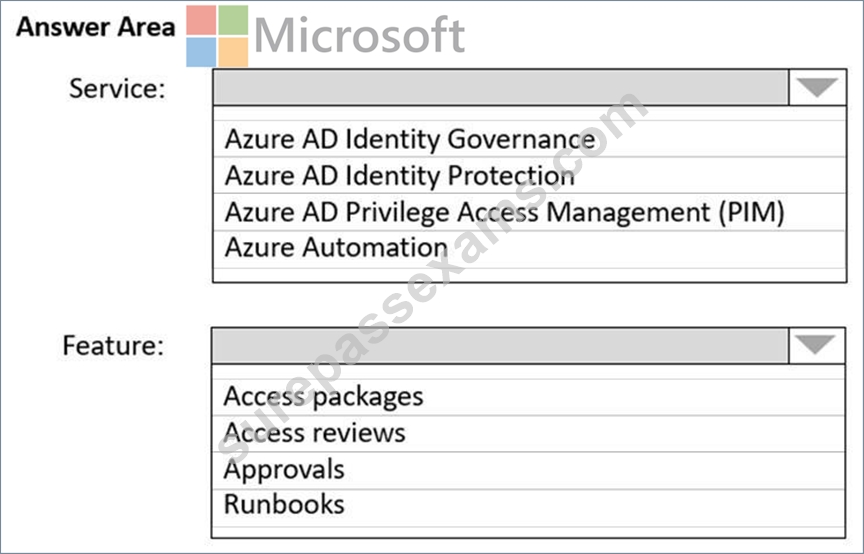
Answer:
Explanation: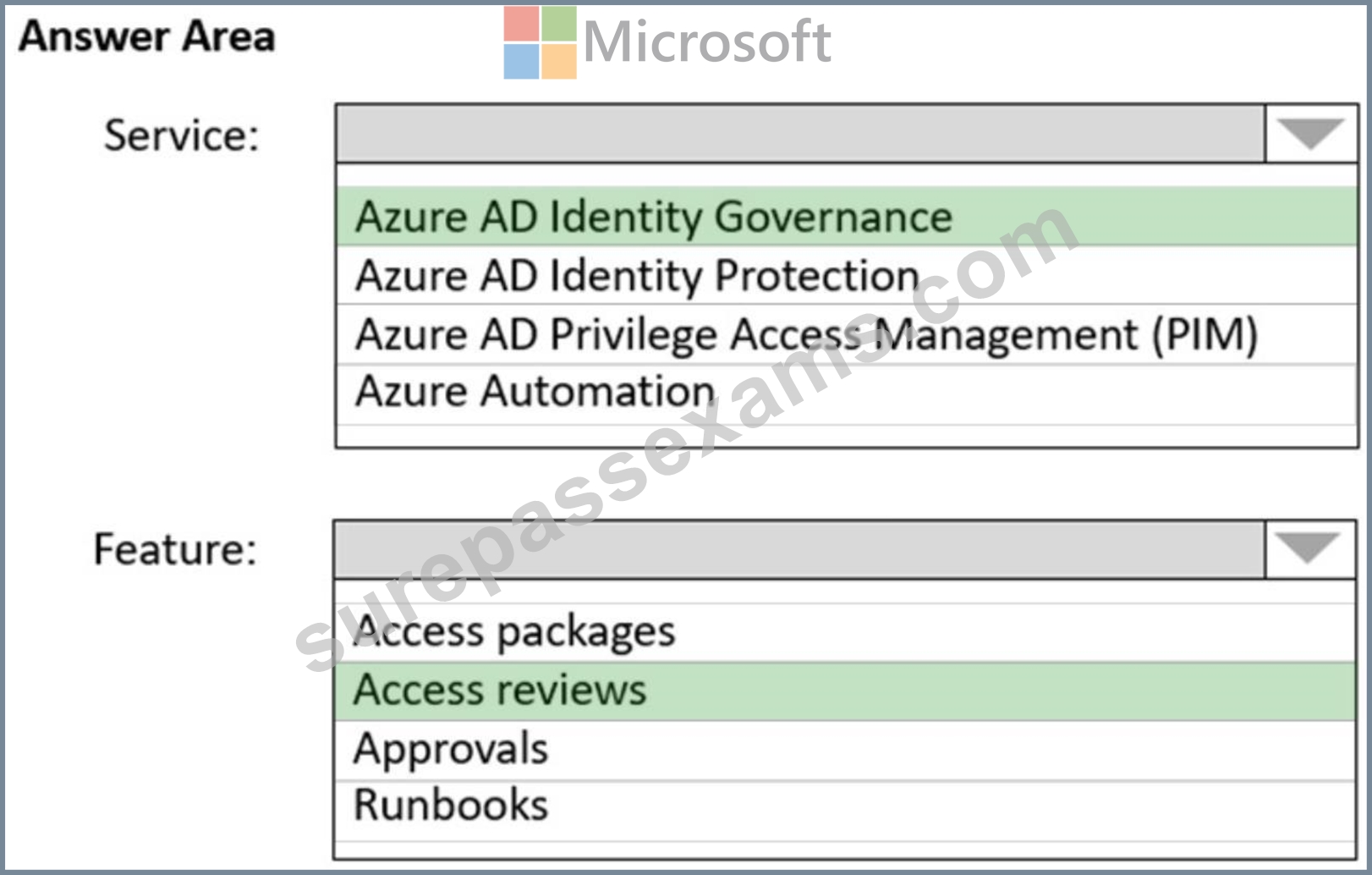
Explanation:
Requirements: Identity Requirements
Contoso identifies the following requirements for managing Fabrikam access to resources:
* Every month, an account manager at Fabrikam must review which Fabrikam users have access permissions to App1. Accounts that no longer need permissions must be removed as guests.
* The solution must minimize development effort.
Box 1: Azure AD Identity Governance
Incorrect:
Not PIM: Life Cycle Requirements must be met.
Box 2: Access reviews
Azure Active Directory (Azure AD) access reviews enable organizations to efficiently manage group memberships, access to enterprise applications, and role assignments. User's access can be reviewed on a regular basis to make sure only the right people have continued access.
Reference:
https://docs.microsoft.com/en-us/azure/active-directory/governance/access-reviews-overview
NEW QUESTION # 243
You manage a database environment for a Microsoft Volume Licensing customer named Contoso, Ltd.
Contoso uses License Mobility through Software Assurance.
You need to deploy 50 databases. The solution must meet the following requirements:
* Support automatic scaling.
* Minimize Microsoft SQL Server licensing costs.
What should you include in the solution? To answer, select the appropriate options in the answer area.
NOTE: Each correct selection is worth one point.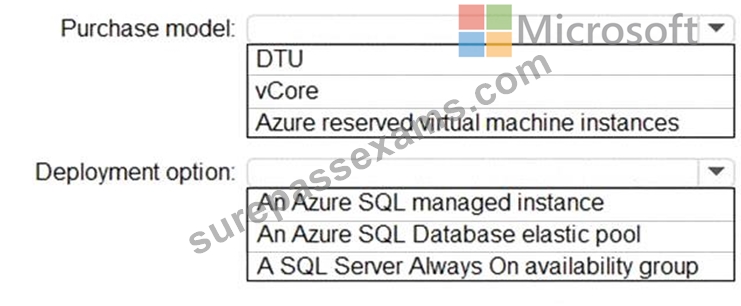
Answer:
Explanation: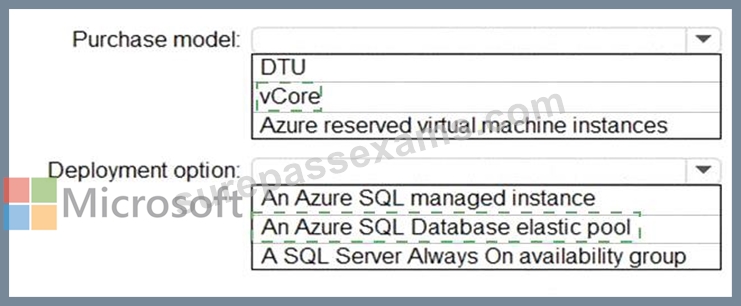
Explanation: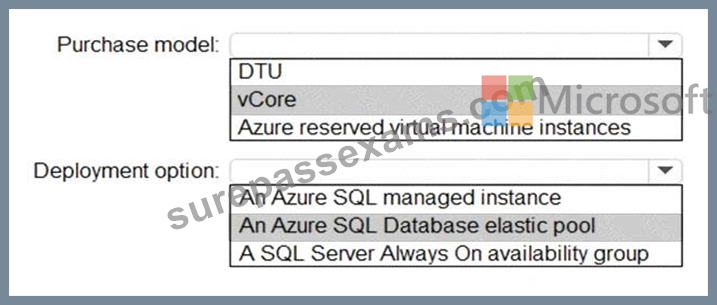
Box 1: vCore
Virtual core (vCore)-based purchasing model (recommended). This purchasing model provides a choice between a provisioned compute tier and a serverless compute tier. With the provisioned compute tier, you choose the exact amount of compute resources that are always provisioned for your workload. With the serverless compute tier, you specify the autoscaling of the compute resources over a configurable compute range Box 2: An Azure SQL Database Elastic pool Azure SQL Database provides the following deployment options for a database:
* Single database represents a fully managed, isolated database.
* Elastic pool is a collection of single databases with a shared set of resources, such as CPU or memory.
Single databases can be moved into and out of an elastic pool.
Reference:
https://docs.microsoft.com/en-us/azure/azure-sql/database/purchasing-models
NEW QUESTION # 244
You plan to deploy multiple instances of an Azure web app across several Azure regions.
You need to design an access solution for the app. The solution must meet the following replication requirements;
* Support rate limiting.
* Balance requests between all instances.
* Ensure that users can access the app in the event of a regional outage.
Solution: You use Azure Traffic Manager to provide access to the app.
Does this meet the goal?
- A. No
- B. Yes
Answer: B
NEW QUESTION # 245
Your company has 20 web APIs that were developed in-house.
The company is developing 10 web apps that will use the web APIs. The web apps and the APIs are registered in the company s Azure AD tenant. The web APIs are published by using Azure API Management.
You need to recommend a solution to block unauthorized requests originating from the web apps from reaching the web APIs. The solution must meet the following requirements:
* Use Azure AD-generated claims.
* Minimize configuration and management effort
What should you include in the recommendation? To answer, select the appropriate options in the answer area.
NOTE: Each correct selection is worth one point.
NOTE: Each correct selection is worth one point.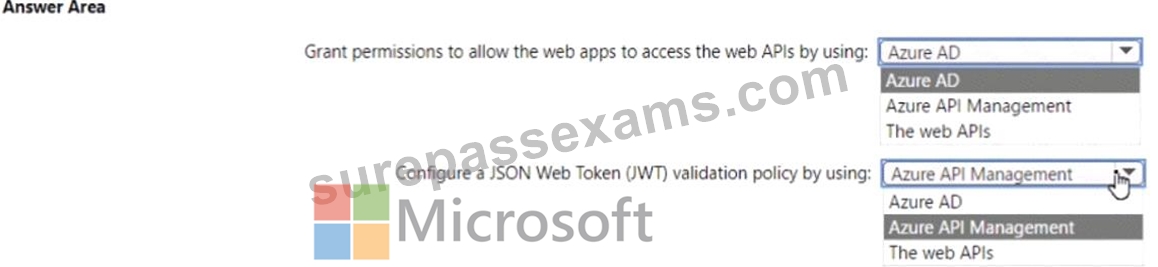
Answer:
Explanation: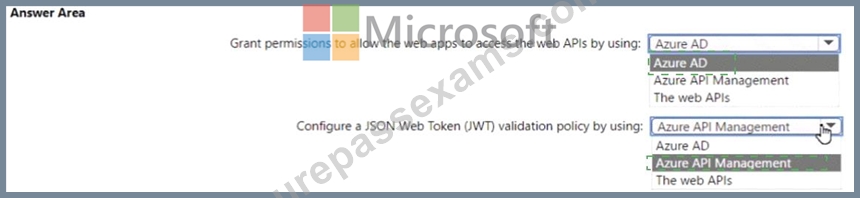
Explanation:
Graphical user interface, text Description automatically generated with medium confidence
NEW QUESTION # 246
You have to deploy an Azure SQL database named db1 for your company. The databases must meet the following security requirements:
- When IT help desk supervisors query a database table named customers, they must be able to see the full number of each credit card
- When IT help desk operators query a database table named customers,
they must only see the last four digits of each credit card number
- A column named Credit Card rating in the customers table must never
appear in plain text in the database system.
- Only client applications must be able to decrypt the information that is stored in this column Which of the following can be implemented for the Credit Card rating column security requirement?
- A. Dynamic Data Masking
- B. Azure Advanced Threat Protection
- C. Transparent Data Encryption
- D. Always Encrypted
Answer: D
Explanation:
https://docs.microsoft.com/en-us/sql/relational-databases/security/encryption/always-encrypted- database-engine?view=sql-server-ver15
NEW QUESTION # 247
You have an Azure subscription that contains a Basic Azure virtual WAN named Virtual/WAN1 and the virtual hubs shown in the following table.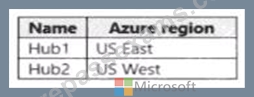
You have an ExpressRoute circuit in the US East region.
You need to create an ExpressRoute association to VirtualWAN1.
What should you do first?
- A. Create a hub virtual network in US East.
- B. Enable the ExpressRoute premium add-on.
- C. Create a gateway on Hub1.
- D. Upgrade VirtualWAN1 to Standard.
Answer: D
Explanation:
US East and US West are in the same geopolitical region so there is no need for enabling ExpressRoute premium add-on https://docs.microsoft.com/en-us/azure/virtual-wan/virtual-wan-about#basicstandard The current config of virtual WAN is only Basic as given, so it can connect to only site to site VPN, to connect to express route it needs to be upgraded from basic to standard. https://docs.microsoft.com/en-us/azure
/virtual-wan/virtual-wan-about
https://docs.microsoft.com/en-us/azure/virtual-wan/virtual-wan-about
NEW QUESTION # 248
You have an Azure subscription that contains an Azure SQL database.
You are evaluating whether to use Azure reservations on the Azure SQL database.
Which tool should you use to estimate the potential savings?
- A. The Advisor blade in the Azure portal
- B. The SQL database blade in the Azure portal
- C. The Purchase reservations blade in the Azure portal
Answer: C
Explanation:
Buy reserved capacity
* Sign in to the Azure portal.
* Select All services > Reservations.
* Select Add and then in the Purchase Reservations pane, select SQL Database to purchase a new reservation for SQL Database.
* Fill in the required fields. Existing databases in SQL Database and SQL Managed Instance that match the attributes you select qualify to get the reserved capacity discount. The actual number of databases or managed instances that get the discount depends on the scope and quantity selected.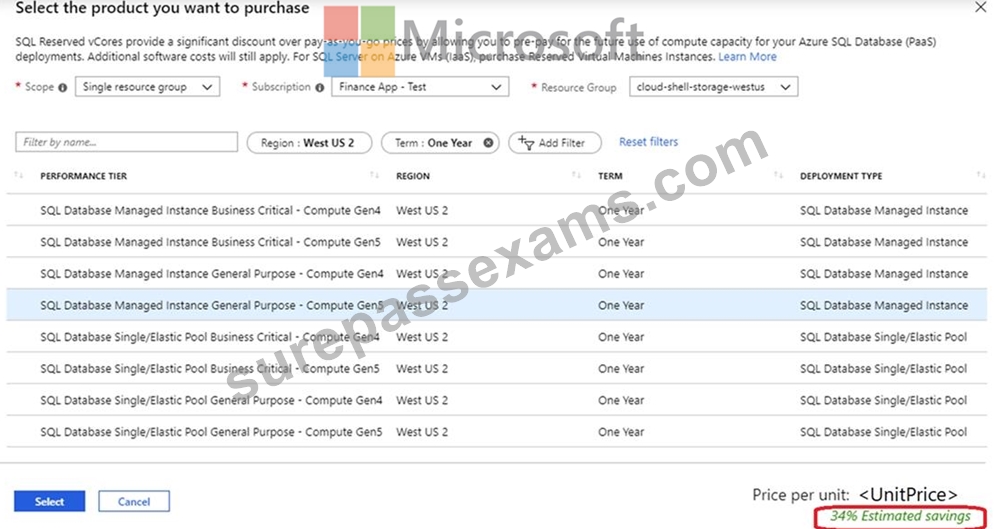
* Review the cost of the capacity reservation in the Costs section.
* Select Purchase.
* Select View this Reservation to see the status of your purchase.
Reference:
https://docs.microsoft.com/en-us/azure/azure-sql/database/reserved-capacity-overview
NEW QUESTION # 249
You need to design an architecture to capture the creation of users and the assignment of roles. The captured data must be stored in Azure Cosmos DB.
Which Azure services should you include in the design? To answer, drag the appropriate services to the correct targets. Each service may be used once, more than once, or not at all. You may need to drag the split bar between panes or scroll to view content.
NOTE:Each correct selection is worth one point.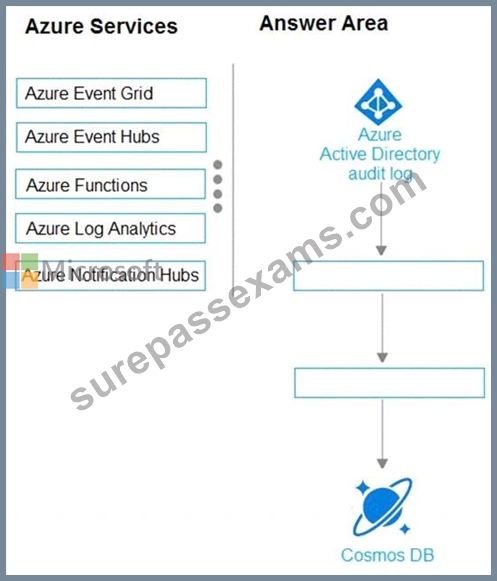
Answer:
Explanation: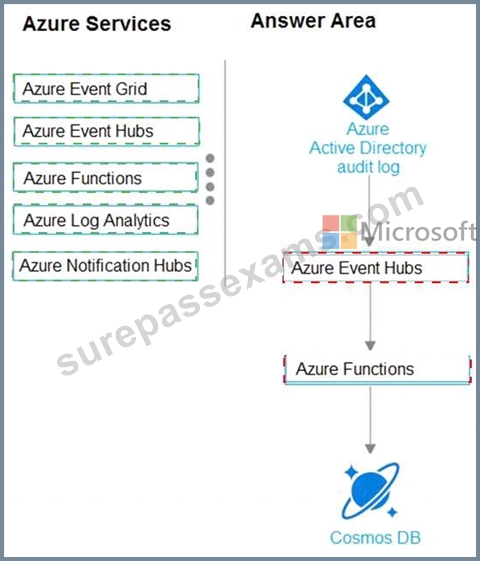
Explanation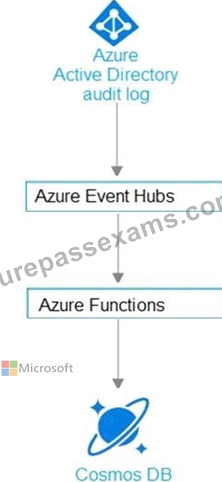
Diagram Description automatically generated
1. AAD audit log -> Event Hub (other two choices, LAW, storage, but not available in this question)
https://docs.microsoft.com/en-us/azure/active-directory/reports-monitoring/tutorial-azure-monitor-stream-logs-to
2. Azure function has the Event hub trigger and Cosmos output binding
a. Event Hub trigger for function
https://docs.microsoft.com/en-us/azure/azure-functions/functions-bindings-event-hubs-trigger?tabs=csharp
NEW QUESTION # 250
Your company has an app named App1 that uses data from the on-premises Microsoft SQL Server databases shown in the following table.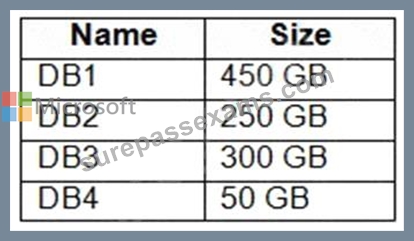
App1 and the data are used on the first day of the month only. The data is not expected to grow more than 3% each year.
The company is rewriting App1 as an Azure web app and plans to migrate all the data to Azure.
You need to migrate the data to Azure SQL Database. The solution must minimize costs.
Which service tier should you use?
- A. DTU-based Standard
- B. vCore-based Business Critical
- C. vCore-based General Purpose
- D. DTU-based Basic
Answer: A
Explanation:
Explanation
DTU-based Standard supports databases up to 1 TB in size.
Reference:
https://docs.microsoft.com/en-us/azure/azure-sql/database/service-tiers-dtu
NEW QUESTION # 251
You plan to deploy a network-intensive application to several Azure virtual machines.
You need to recommend a solution that meets the following requirements:
Minimizes the use of the virtual machine processors to transfer data
Minimizes network latency
Which virtual machine size and feature should you use? To answer, select the appropriate options in the answer area.
NOTE: Each correct selection is worth one point.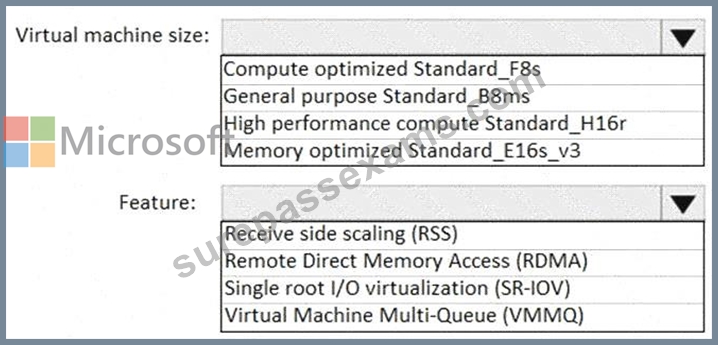
Answer:
Explanation: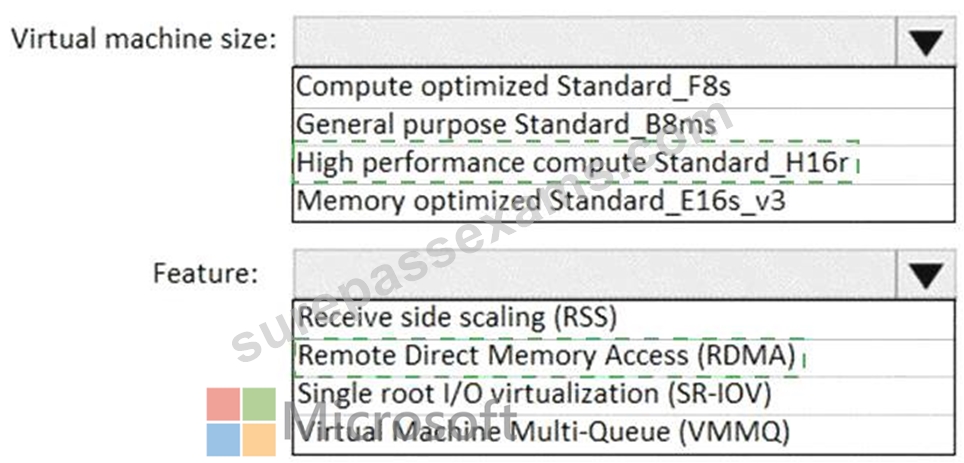
Explanation: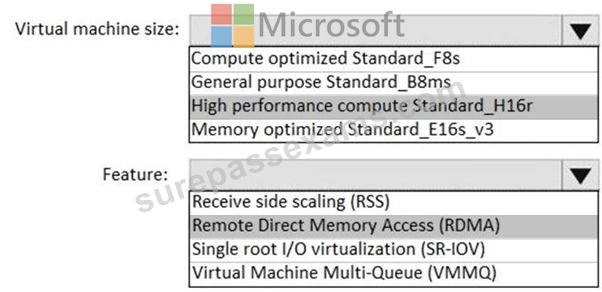
References:
https://docs.microsoft.com/en-us/azure/virtual-machines/windows/sizes-hpc#h-series
NEW QUESTION # 252
......
New AZ-305 Exam Dumps with High Passing Rate: https://www.surepassexams.com/AZ-305-exam-bootcamp.html
AZ-305 Certification Exam Dumps with 475 Practice Test Questions: https://drive.google.com/open?id=1yPYcblvSSbXutLPpNY0ixddRGHd5KVyC