Study with Linux Foundation : CKAD Exam Torrent as your best preparation materials
Last Updated: Nov 07, 2026
No. of Questions: 239 Questions & Answers with Testing Engine
Download Limit: Unlimited
Professional & Latest Exam Preparation materials for CKAD Exam
Our SurePassExams CKAD Exam Preparation materials are famous for its high pass-rate. Actual studying content will help you pass exam for sure. Also different study methods will give you different choices and different preparing experience. CKAD exam torrent files can help you prepare easily and get doubt result with half effort. Our Soft test engine and Online test engine will provide you simulation function so that you can have a good mood after studying deeply.
100% Money Back Guarantee
SurePassExams has an unprecedented 99.6% first time pass rate among our customers.  We're so confident of our products that we provide no hassle product exchange.
- Best exam practice material
- Three formats are optional
- 10 years of excellence
- 365 Days Free Updates
- Learn anywhere, anytime
- 100% Safe shopping experience
- Instant Download: Our system will send you the products you purchase in mailbox in a minute after payment. (If not received within 12 hours, please contact us. Note: don't forget to check your spam.)
Linux Foundation CKAD Practice Q&A's

- Printable CKAD PDF Format
- Prepared by CKAD Experts
- Instant Access to Download
- Study Anywhere, Anytime
- 365 Days Free Updates
- Free CKAD PDF Demo Available
- Download Q&A's Demo
Linux Foundation CKAD Online Engine

- Online Tool, Convenient, easy to study.
- Instant Online Access
- Supports All Web Browsers
- Practice Online Anytime
- Test History and Performance Review
- Supports Windows / Mac / Android / iOS, etc.
- Try Online Engine Demo
Linux Foundation CKAD Self Test Engine

- Installable Software Application
- Simulates Real Exam Environment
- Builds CKAD Exam Confidence
- Supports MS Operating System
- Two Modes For Practice
- Practice Offline Anytime
- Software Screenshots
Better job titles and better salaries tend to follow Linux Foundation credentials, and the Linux Foundation Certified Kubernetes Application Developer is a proven first rung. In 2026, SurePassExams prepares you for it with 239 practice questions for the CKAD exam, each backed by a verified answer.
Linux Foundation CKAD Exam Overview:
| Certification Vendor: | Linux Foundation |
|---|---|
| Exam Name: | Certified Kubernetes Application Developer (CKAD) Exam |
| Exam Number: | CKAD |
| Passing Score: | 66% |
| Exam Format: | Command-line, Performance-based |
| Related Certifications: | Certified Kubernetes Application Developer (CKAD) |
| Exam Duration: | 120 minutes |
| Available Languages: | English |
| Real Exam Qty: | 15-20 (performance-based tasks) |
| Exam Price: | USD 445 |
| Certificate Validity Period: | 3 years |
| Sample Questions: | DOWNLOAD DEMO |
| Exam Way: | Online, proctored exam via PSI Secure Browser (performance-based in a command-line environment). |
| Pre Condition: | No mandatory prerequisites, but working knowledge of container runtimes and microservice architecture is recommended. |
| Official Syllabus URL: | https://training.linuxfoundation.org/certification/certified-kubernetes-application-developer-ckad/ |
Linux Foundation CKAD Exam Syllabus Topics:
| Section | Weight | Objectives |
|---|---|---|
| Topic 1: Application Deployment | 20% | - Kustomize - Use Kubernetes primitives to implement common deployment strategies (e.g., blue/green or canary) - Use the Helm package manager to deploy existing packages - Understand Deployments and how to perform rolling updates |
| Topic 2: Services and Networking | 20% | - Use Ingress rules to expose applications - Provide and troubleshoot access to applications via services - Demonstrate basic understanding of NetworkPolicies |
| Topic 3: Application Design and Build | 20% | - Choose and use the right workload resource (Deployment, DaemonSet, CronJob, etc.) - Define, build and modify container images - Utilize persistent and ephemeral volumes - Understand multi-container Pod design patterns (e.g., sidecar, init and others) |
| Topic 4: Application Environment, Configuration and Security | 25% | - Understand authentication, authorization and admission control - ConfigMaps and Secrets - Discover and use resources that extend Kubernetes (CRD, Operators) - Understanding and defining resource requirements, limits and quotas - ServiceAccounts - SecurityContexts |
| Topic 5: Application Observability and Maintenance | 15% | - Implement probes and health checks - Understand API deprecation policies - Debugging in Kubernetes - Utilize container logs - Use built-in CLI tools to monitor Kubernetes applications |
Linux Foundation Certified Kubernetes Application Developer FAQ: Straight Answers Before You Study
On delivery: the download is available the moment your payment clears, and a copy reaches your email within one minute. If 2 hours pass and nothing arrives, check spam and contact our support team. Install the software on as many computers as you need — there is no device limit.
On outcomes: if you take the CKAD exam within 60 days of purchase and do not pass, the SurePassExams money back guarantee applies. File your claim within 2 days of the exam with a scanned enrollment slip and the official score report (PDF); claims are processed within 7 days. The candidate name must match the payer name, and the policy excludes exams taken within 3 days of purchase, purchases never used in an actual exam attempt, free materials, and expired orders. Alternatively, you can exchange the product for two free exam packages of equal value and keep the update service on your original purchase.
The CKAD exam gives you 120 minutes to work through 15-20 (performance-based tasks) questions. That pace punishes perfectionism — the candidates who struggle are usually the ones who burned ten minutes on one stubborn item. Train the skill directly: take timed, full-length mocks in the SurePassExams desktop or online test engine, practice skipping and returning, and walk in with a pacing strategy you have already tested.
No mandatory prerequisites, but working knowledge of container runtimes and microservice architecture is recommended.
Vendor requirements do change, so before you commit to an exam date, confirm the latest eligibility rules on the official Linux Foundation exam page.
The Linux Foundation Certified Kubernetes Application Developer syllabus is split into 5 domains, anchored by Application Deployment (20%), Application Observability and Maintenance (15%), and Application Environment, Configuration and Security (25%). The full breakdown sits in the syllabus section above — treat it as the checklist that decides where your study hours go.
The passing mark for the CKAD exam is 66%, and the official registration fee is USD 445. Remember that the fee covers a single attempt — fail, and the retake costs the same again with no loyalty discount. Protect the budget by self-testing first: drill 239 practice questions at SurePassExams under timed conditions until your scores clear the bar with margin, then register.
The CKAD exam, officially the Linux Foundation Certified Kubernetes Application Developer Exam, is Linux Foundation's benchmark for proving you can work with its technologies in professional settings; passing it awards the Kubernetes Application Developer certification, which sits at the Intermediate level. Because the credential is issued by the vendor itself, it carries weight with employers that self-assessed skills simply cannot match. It also opens the road toward Certified Kubernetes Application Developer (CKAD).
Yes — SurePassExams publishes a free PDF demo of the CKAD materials so you can check the question quality and verified answers before paying anything. Once you purchase, 365 days of free updates come standard, and if your product expires you can renew the update service at a 50% discount from your member zone.
Linux Foundation Certified Kubernetes Application Developer Sample Questions:
You are building a microservice that relies on a third-party API for its functionality_ To ensure the reliability and performance of your microservice, you need to implement a robust strategy tor handling API calls. Design a deployment strategy that addresses potential issues with the third-pany API and ensures the stability of your microservice.
Reveal Solution Discussion 0Correct Answer:
See the solution below with Step by Step Explanation.
Explanation:
Solution (Step by Step) :
I). Use a Deployment:
- Deploy your microservice using a Deployment. Deployments provide a robust mechanism for managing and scaling your microservices, making it easy to update and manage your application.
2. Secure API Credentials: - Store API credentials (like API keys or tokens) securely using a Kubernetes Secret. This prevents credentials from being exposed in plain text within your deployments.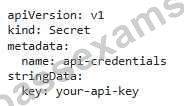
3. Implement Retry Mechanisms: - Add retry logic to your code to handle transient errors (like network hiccups or temporary service outages) during API calls. This helps ensure that your microservice can recover from temporary issues and continue functioning. 4. Utilize Rate Limiting: - Implement rate limiting to prevent your microservice from ovenvhelming the third-party API. This helps protect both your microservice and the API from performance degradation- 5. Use a Circuit Breaker Pattern: - Integrate a circuit breaker pattern into your API call handling. This pattern helps prevent cascading failures by automatically stopping requests to the third-party API it it is experiencing prolonged outages or errors- 6. Consider a Proxy or Gateway: - Implement a proxy or gateway layer between your microservice and the third-party API. This layer can help with request routing, load balancing, security, and performance optimization. 7. Monitor API Calls: - Implement monitoring and logging to track API call performance and identify potential issues. This allows you to proactively identify and address problems before they impact your microservice's reliability 8. Utilize Caching: - Consider caching API responses to reduce the load on the third-party API and improve the response time of your microservice. 9. Implement Fallbacks: - Have fallback mechanisms in place if the third-party API is unavailable. This could involve returning default data or using alternative data sources to provide a degraded but functional experience. 10. Consider Using a Service Mesh: - For complex microservice architectures, consider implementing a service mesh like Istio. Service meshes provide features like traffic management, security, observability, and resilience, which can be very beneficial for managing interactions with third-party APIs.,
You have a Deployment running a container image for a web application. The application's configuration files are currently stored within the image itself. you want to move the configuration files to a ConfigMap so that they can be updated independently or the application image. Describe the steps involved in modifying the Deployment and creating a ConfigMap to achieve this separation.
Reveal Solution Discussion 0Correct Answer:
See the solution below with Step by Step Explanation.
Explanation:
Solution (Step by Step) :
1. Create a ConfigMap:
- Create a ConfigMap using 'kubectl create configmap' with the configuration files. For example:
kubectl create configmap webapp-config -from-literal=config.json='{"port": 8080, "database_url": "mongodb://localhost27017"}'
- Replace 'config_json' with the name of your configuration file and the JSON content with your actual configuration values.
2. Modify the Deployment:
- Modify your Deployment YAML file to mount the ConfigMap as a volume. Here's an example:
- Modify your application code to read configuration files from '/etctwebapp/config' 3. Apply the Changes: - Apply the updated Deployment using 'kubectl apply -f deployment_yamr 4. Verify the Update: - Check the logs of the pods using 'kubectl logs -f You should see the application loading configuration values from the ConfigMap. 5. Update the Configuration: - You can now update the configuration files within the ConfigMap without rebuilding the image. For example.
- This will update the ConfigMap and trigger a rolling update of the Deployment, effectively updating the application configuration without rebuilding the image.
You are building a microservices application with two services, 'user-service' and 'order-service'. Both services have dedicated Dockerfiles for building their container images. You want to optimize the image build process by minimizing the size of the final images. You also want to ensure that the image build process is reproducible and reliable. How can you achieve these goals using Dockerfile best practices and multi-stage builds?
Reveal Solution Discussion 0Correct Answer:
See the solution below with Step by Step Explanation.
Explanation:
Solution (Step by Step) :
1. Use Multi-Stage Builds:
- Define two stages in your Dockerfile: a 'build' stage for compiling dependencies and a 'runtime stage for running the final application.
- Copy only the essential files and dependencies from the 'builds stage to the 'runtime' stage.
dockerfile
FROM golang:1.18 as build
WORKDIR /app
COPY . .
RUN go mod download
RUN go build -o user-service .
FROM alpine:latest as runtime
COPY --from-build lapp/user-service fuser-service
CMD ["/user-service"]
2. Minimize Image Size:
- Use a minimal base image: 'alpine:latest' is a lightweight Linux distribution.
- Remove unnecessary files: Use SRIJN apt-get clean' to remove package cache.
- Leverage Docker layers: Separate build steps to minimize the number of layers recreated during subsequent builds.
- Use 'COPY instead of 'ADDS: 'COPY' avoids unpacking archives, making the image smaller.
- Install only required dependencies: use package managers to install only the necessary libraries and tools.
3. Reproducibility and Reliability:
- Define a clear build context: use a ' .dockerignore' file to exclude unnecessary files from the build context.
- Leverage Docker caching: Arrange Dockerfile instructions to maximize the use of cacned layers.
- Use 'go mod vendor to vendor dependencies for improved build reproducibility.
- Use a consistent environment for building images: I-Jse a Dockerfile builder image that is compatible with the development environment.
4. Implement for Both Services:
- Apply the same best practices to the 'order-service' Dockerfile.
- Create a separate Dockerfile for each service and use consistent naming conventions (e.g.
'Dockerfile.user-service', 'Dockerfile-order-service').
5. Test and Validate.
- Build and push the images to a registry-
- Run the services in a Kubernetes cluster and verify their functionality.
- Measure image sizes to confirm that tne optimization efforts nave been successful.
By implementing these steps, you can create smaller, more reproducible, and reliable Docker images for your microservices, leading to faster build times and more efficient deployments.,
You are tasked witn building a container image for a Node.js application that needs to interact with a MongoDB database. Describe now you would configure your Dockerfile to include MongoDB and how you would set up your Node.js application to connect to the database within the container.
Reveal Solution Discussion 0Correct Answer:
See the solution below with Step by Step Explanation.
Explanation:
Solution (Step by Step) :
1. Utilize a Multi-Stage Dockerfile: Employ a multi-stage Dockerfile to separate the build and runtime environments, optimizing the final image size.
2. Install MongoDB in the Base Image: - Use a suitable MongoDB base image, such as 'mongo:latest', in the runtime stage. 3. Install Node.js Dependencies: - IJse a Nodejs base image, such as 'node:16-alpine', in the build stage. - Install Node.js dependencies using 'yarn install'. 4. Connect to MongoDB from the Node.js Application: - In your Node.js application, use a MongoDB driver (e.g., 'mongodb') to establish a connection to the MongoDB instance.
5. Build and Run the Container: - Build the image using 'docker build . -t my-node-mongo-apps - Run the container using 'docker run -it -p 2701727017 my-node-mongo-app' - The '-p 27017:27017' mapping exposes the MongoDB port to your host machine, allowing you to connect to the database from your local machine. 6. Access MongoDB. - You can use a MongoDB client tool (e.g., Mongo Shell, Robo 3T) or other applications to connect to the MongoDB instance running inside the container.,
You have a Deployment named 'my-app-deployment' running an application that requires a specific version of a database. This version is available in a private Docker registry with access credentials stored in a Secret. How would you configure the Deployment to pull the database image from the private registry using the Secret's credentials?
Reveal Solution Discussion 0Correct Answer:
See the solution below with Step by Step Explanation.
Explanation:
Solution (Step by Step) :
1. Create a Secret:
- Create a secret containing the usemame and password required to access the private registry.
- Replace 'your-registry-username' and 'your-registry-password' with your actual credentials.
2. Update the Deployment - Modify the Deployment configuration to include the 'imagePullSecrets' field. - Add the name oftne secret you created in the previous step. - Replace 'your-private-registry-domain/your-database-image:your-version' with the actual image name and version.
3. Apply the Changes: - Apply the updated Deployment configuration using 'kubectl apply -f my-app-deployment.yamr. 4. Verify the Pull: - Check the logs of the Pods in the Deployment. You should see messages indicating that the database image is pulled from the private registry using the provided credentials.
Viewing page 1 out of 48 pages.
Viewing questions 1-5 out of 239 questions.
 Allen
Benedict
Chapman
Earl
Gregary
Jerry
SurePassExams is the world's largest certification preparation company with 99.6% Pass Rate History from 58867+ Satisfied Customers in 148 Countries.

Over 58867+ Satisfied Customers