

Latest Verified & Correct Salesforce Plat-Dev-210 Questions & Answers Daily Updated
100% Pass Guaranteed Download Salesforce Developer Exam PDF Q&A
NEW QUESTION # 39
A developer needs to configure a DataRaptor to retrieve data from a single object. The structure of the output data does not need to be changed.
Following best practices, which type of DataRaptor should the developer use?
- A. DataRaptor Extract
- B. DataRaptor Transform
- C. DataRaptor Load
- D. DataRaptor Turbo Extract
Answer: D
Explanation:
A DataRaptor Turbo Extract is a simplified version of a DataRaptor Extract that can retrieve data from a single object without changing the structure of the output data. It is suitable for this scenario because the developer does not need to transform or load the data
NEW QUESTION # 40
A developer needs to display read-only contact information in a OmniScript. The developer will format the information as a table, using merge codes to dynamically include first name, last name, street address, state, postal, code, and country from the data JSON.
Which OmniScript element should the developer use to meet this requirement?
- A. Text Block
- B. Text area
- C. Edit Block
- D. Rich text Area
Answer: A
Explanation:
A Text Block element allows the developer to display read-only text in a table format, using merge codes to dynamically include data from the data JSON. A Rich Text Area element is used to display formatted text with images and links. A Text Area element is used to display editable text in a single line or multiple lines.
An Edit Block element is used to display editable fields in a form layout.
NEW QUESTION # 41
Users receive an APEC CPU limit Exceeded error when running an OmniScript in a Salesfoce Community.
The OmniScript includes an Integration Procedure that contains two DataRaptors.
Which two Location should the developer check to troubleshoot the issue?
Choose 2 answers
- A. Script configuration
- B. Action Debugger
- C. Community logs
- D. DataRaptor configuration
Answer: B,D
Explanation:
According to the Troubleshoot Flow Errors page, one way to troubleshoot errors is to "check the debug logs for the community". Another way is to use the Action Debugger tool, which "lets you test and debug actions in OmniStudio".
NEW QUESTION # 42
What should a developer's first step be when troubleshooting whether a DataRaptor Extract is retrieving data?
- A. Add a key/value pair in the DataRaptor to test it.
- B. Deactivate the card and layout, and go to the PREVIEW tab for the card to test.
- C. Go to the Lightning Console and reload the page to test.
- D. Go to the PREVIEW tab In OmniScript to test.
Answer: D
Explanation:
The PREVIEW tab in OmniScript allows the developer to test the DataRaptor Extract by providing a record ID and viewing the output data. This is a quick and easy way to troubleshoot whether the DataRaptor Extract is retrieving data correctly.
NEW QUESTION # 43
A developer configures a Flexcard with a DataRaptor data source that uses the params.id as an. When the developer clicks Views Data on the FlexCard, valid data displays. However, when the developer previews the layout, the FlexCard does not display. What could cause this error?
Choose 2 answers
- A. The attribute hasn't been configured to pass the data to the fields.
- B. The Record Id in the Test Data Source settings ins for the wrong record type.
- C. There is not Salesforce record for the FlexCard based on the Record Id in the layout's Test Data Source Settings.
- D. The Data Node field for the FlexCard is empty.
Answer: C,D
Explanation:
The Data Node field for the FlexCard is required to specify which data source will be used to populate the FlexCard. If it is empty, the FlexCard will not display any data. The Record Id in the Test Data Source settings is used to preview the layout with a specific record. If there is no Salesforce record for that Record Id, the FlexCard will not display any data either.
NEW QUESTION # 44
Which calculation procedure version in the list would execute on 2/15/2020at 12:00 PM?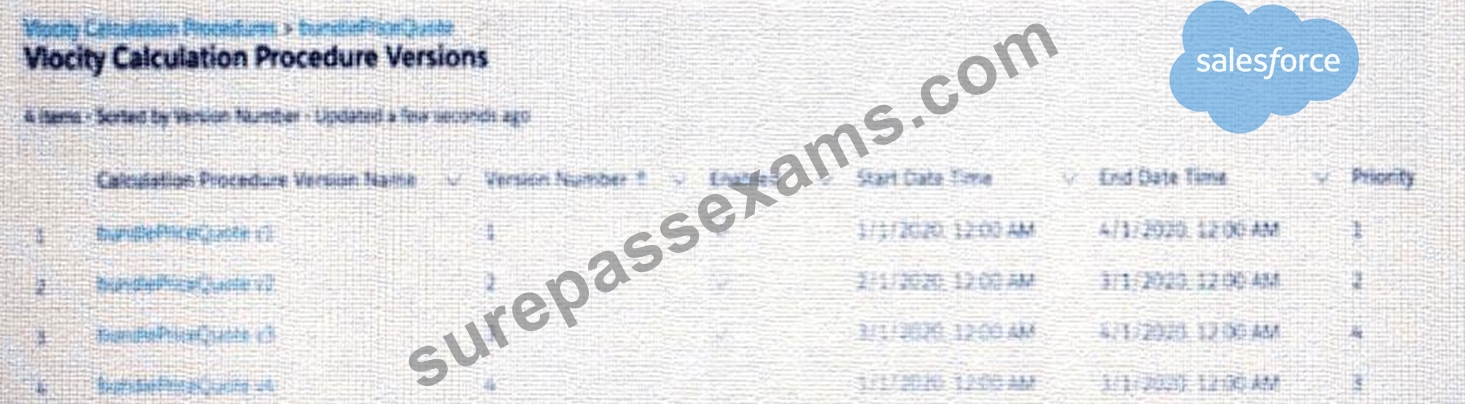
- A. Version Number 1
- B. Version Number 4
- C. Version Number 3
- D. Version Number 2
Answer: B
Explanation:
the calculation procedure version that would execute on 2/15/2020 at 12:00 PM is the one that has the start date time and end date time that include that date and time, and also has the highest priority among the enabled versions. In this case, only version number 4 meets these criteria, as it has a start date time of 2/1
/2020 12:00 AM, an end date time of 4/1/2020 12:00 AM, a priority of 1, and is enabled. The other versions either have a different start or end date time, a lower priority, or are not enabled.
NEW QUESTION # 45
Refer to the exhibit.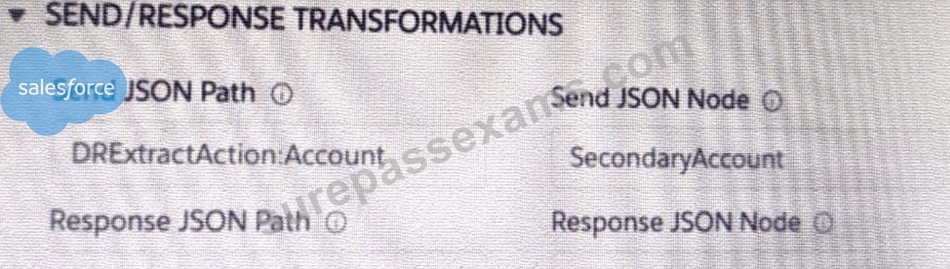
A developer has configured an integration Procedure element with SEND/RESPONSETRANFORMATIONS as shown.
Alternatively, how could the developer configure Additional input to send exactly the same data? Assume that the developer checked Send Only Additional input.
- A.

- B.

- C.

Answer: A
Explanation:
Option C is the correct way to configure Additional input to send exactly the same data as Input Data. The Additional input should have a key/value pair for each field in Input Data, and the value should be set to
{{InputData.field}} for each field. This will pass the value of Input Data for each field to Additional input.
NEW QUESTION # 46
When launching an OmniScript from an action on a FlexCard, the OmniScript displays, but no Salesforce data is populated:
Which two errors could cause this behavior?
Choose 2 answers
Choose 2 answers
- A. In the DataRaptor Extract Action, the Input Parameters Filter Value is misspelled.
- B. There is no active version of the Data Raptor Extract.
- C. The Id Field for Actions in the FlexCard is blank.
- D. There is non active version of the OmniScript
Answer: A,C
Explanation:
The Id Field for Actions in the FlexCard specifies which field from the FlexCard data source will be used as the record ID for the OmniScript. If this field is blank, the OmniScript will not receive any record ID and will not be able to retrieve any Salesforce data. In the DataRaptor Extract Action, the Input Parameters Filter Value determines how to filter the data based on the record ID. If this value is misspelled, the DataRaptor Extract will not be able to match the record ID and will not return any data.
NEW QUESTION # 47
A developer writes an OmniScript that includes a DataRaptor that updates the Account statue based on information provided from the OmniScript. The information must be updated only if the Account record already exists. Otherwise, a new account must be created.
How should the developer accomplish this task?
- A. Check Overwrite Target for all Null input checkbox on the Account id field
- B. Check the Upset key and is required for Upsert checkboxes on the Account id field
- C. Populate the Lookup object and Lookup fields
- D. Check the Upsert key checkbox on the Account Status field
Answer: B
Explanation:
According to the OmniStudio Developer Guide, "To upsert a record, select the Upsert Key checkbox for the field that contains the unique identifier for the record. If you want to create a new record when no match is found, select Is Required for Upsert." Therefore, the correct answer is B.
NEW QUESTION # 48
A healthcare company wants to enable its subscribers to add, edit, or delete dependents related to their policy Community portal. The developer on the project decides to use an MniScript.
How should the developer configure the OmniScript to providethis functionality?
- A. Use an Input Block element and a DataRaptor Post Action element.
- B. Use an Edit Block element configured with Remote Actions.
- C. Use a Text Block element and a Remote Action element.
- D. Use an Edit Block element configured with SOQL statements.
Answer: B
Explanation:
An Edit Block element configured with Remote Actions allows the developer to create a dynamic table that can display, add, edit, or delete records from a Salesforce object. The Remote Actions can be configured to perform CRUD operations on the object using SOQL or Apex.
NEW QUESTION # 49 
- A.

- B.

Answer: A
Explanation:
The correct answer is Option B, which shows a FlexCard with a header, a body, and a footer. The header contains the title and the icon of the FlexCard. The body contains a Data table element that displays the records from the parent FlexCard. The footer contains a navigation Action that invokes an OmniScript.
Option A is incorrect because it shows a FlexCard with only a header and a body, and no footer.
NEW QUESTION # 50
A developer needs to transform contact data into a JSON array.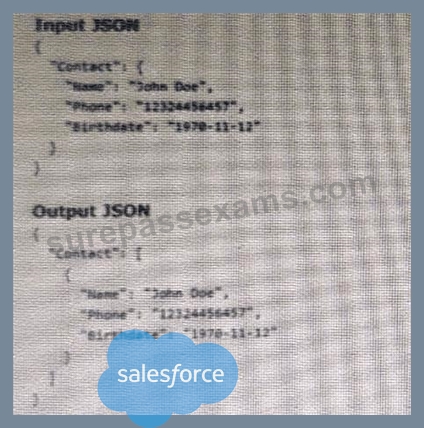
Given the input JSON shown above, what are two ways a developer could configure a DATA Raptor transform to achieve the expected Output JSON? Choose 2 answers
- A. Set the Input JSON path as List(Contact) and the Output JSON Path as Contact.
- B. Use a formula LIST(Contact), and add the output of the formula as the input in the Transform tab.
- C. Set the Input JSON Path as Contact the out JSON Path as Contact and the output Data type as List.
- D. Set the input JSON Path as Contact and the OutPut JSON Path as List (Contact)
Answer: B,C
Explanation:
A DataRaptor Transform can be used to transform data from one format to another, such as JSON, XML, or CSV. The developer can specify the input and output paths for each field in the Transform tab. The developer can also use formulas to manipulate data in the Formula tab1. To transform contact data into a JSON array, the developer can use either of these methods:
* Use a formula LIST(Contact), and add the output of the formula as the input in the Transform tab. This will create a list of contact objects from the input JSON and output it as a JSON array.
* Set the Input JSON Path as Contact, the Output JSON Path as Contact, and the Output Data Type as List. This will output each contact object as an element of a JSON array.
NEW QUESTION # 51
A developer creates a Flexcard that displays a contact's mailing address and passes the contact's postal code to a child FlexCard.
When configuration text elements in the child FlexCard, what syntax should a developer use to refer to the contact's postal code?
- A. {Postalcode}
- B. {Records.postalcode}
- C. {Params.postalcode}
- D. {Parent.postalcode}
Answer: C
Explanation:
The Params node contains the data that is passed from the parent FlexCard to the child FlexCard. The developer should use {Params.postalcode} to refer to the contact's postal code in the child FlexCard.
NEW QUESTION # 52
A customer has a new Engagement Manager who is going to be the new Primary Contact for the Account.
What type of mapping does a DataRaptor Load use to create the new contact and then add it as the new Primary Contact?
- A. Relationship Query
- B. Lookup Key
- C. Lookup Mapping
- D. Linked Mapping
Answer: D
Explanation:
According to the DataRaptor Load Overview page, a Linked Mapping is used to "create or update multiple records in different objects that are related by lookup fields".
NEW QUESTION # 53
A developer is creating a FlexCard for a new Community page. The FlexCard will display case information along with actions to close the case and update the case, and it will be styled using the Community's theme.
What must the developer do to configure the FlexCard for deployment in a community?
- A. Set the Deployment property in Card Configuration to "Community"
- B. Add the FlexCard's API name to the FlexCard Player component
- C. Configure the Component Visibility in the Custom Component
- D. Set the Target property in Publish Options to "CommunityPage"
Answer: B
Explanation:
The FlexCard Player component is used to display FlexCards in a community page. The developer needs to add the FlexCard's API name to the FlexCard Player component to configure the FlexCard for deployment in a community.
NEW QUESTION # 54
A developer needs to configure a calculation procedure to calculation a subtotal using two different depending on whether the input Boolean variable is Customer is set to true or false.
How should a developer configure the calculation procedure to conditionally execute the correct formula?
- A. Use two separate Calculation Steps with the Conditional Step property selected: use the ISTRUE (is Customer) and NOT (ISTRUE) (is Customer) functions in the Condition syntax.
- B. Use a single Calculation Steps with IF statement directly in the formula definition to reference the isCustomer variable and conditionally perform the appropriate calculation.
- C. Use two separate Calculation Steps with the Conditional Step property selected: reference just the is Customer variable in the Conditional syntax (no comparison necessary)
- D. Use two separate Calculation Steps with the Conditional Step property selected: compare theisCustomer variable directly to the literal true and false values in the Condition syntax.
Answer: A
Explanation:
Using two separate Calculation Steps with the Conditional Step property selected allows the developer to specify different formulas based on different conditions. The ISTRUE(isCustomer) and NOT(ISTRUE (isCustomer)) functions are used to evaluate the Boolean variable in the Condition syntax. The other options are either missing the Conditional Step property, using incorrect comparison operators, or using an IF statement instead of separate Calculation Steps.
NEW QUESTION # 55
A developer needs to change some field labels on a FlexCard. The FlexCard is currently deployed to production. The developer that the best course of action is to version the FlexCard rather than cloning it.
Which factor would lead the developer to this decision?
- A. The new version of the FlexCard will be used in a new Console, and the current version of the FlexCard should remain unchanged.
- B. All instances of the FlexCard must be updated with the changes.
- C. Another team member is developing new actions, fields, and styling for the current version of the FlexCard.
- D. The new and current versions will be displayed together on the same target.
Answer: B
Explanation:
Versioning a FlexCard allows the developer to make changes to the FlexCard without affecting the existing instances of the FlexCard. The developer can choose to update all instances of the FlexCard with the new version or keep them as they are. This is useful when the changes are minor and do not affect the functionality or layout of the FlexCard. Cloning a FlexCard creates a copy of the FlexCard with a new name and ID. The developer can make changes to the cloned FlexCard without affecting the original FlexCard. This is useful when the changes are major and require a different configuration or design of the FlexCard1. In this case, since all instances of the FlexCard must be updated with the changes, versioning is the best course of action.
NEW QUESTION # 56
......
Salesforce Plat-Dev-210 Exam Syllabus Topics:
| Topic | Details |
|---|---|
| Topic 1 |
|
| Topic 2 |
|
| Topic 3 |
|
| Topic 4 |
|
| Topic 5 |
|
Plat-Dev-210 PDF Dumps Are Helpful To produce Your Dreams Correct QA's: https://www.surepassexams.com/Plat-Dev-210-exam-bootcamp.html
Plat-Dev-210 Practice Test Dumps with 100% Passing Guarantee: https://drive.google.com/open?id=1ZZMzSZ-sP8EtpXW_PKAlON3u2yH35CLI